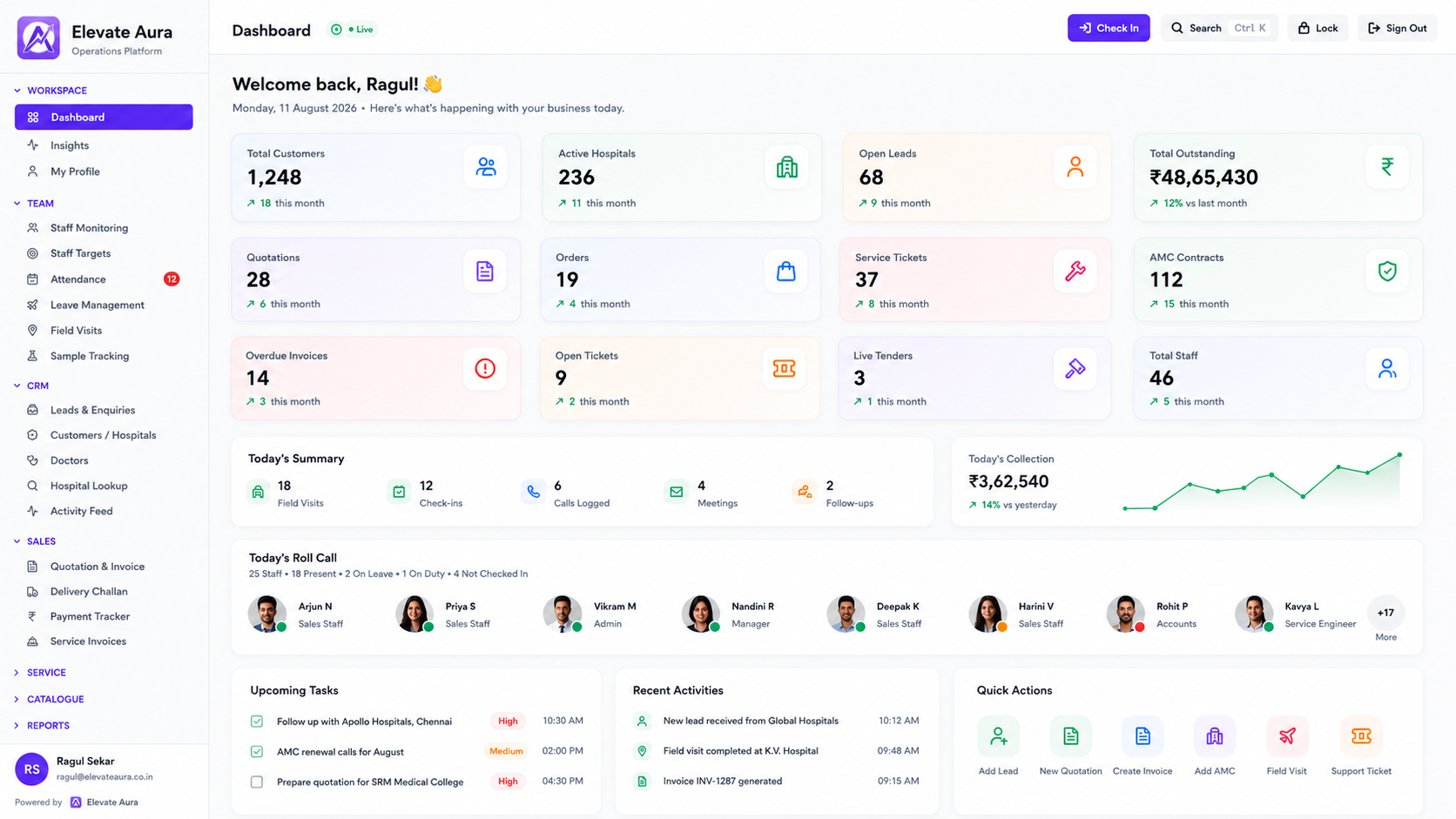
Aura Business runs the parts of a distribution business that usually sit in five separate places: what you hold, what you sold, what you billed under GST, what is still owed, and what your field team did about it.

A distributor in India is judged on five things: whether the stock figure is right, whether the order reached the customer, whether the tax invoice is clean, whether the money came back, and whether the after-sales promise was kept. Distributor management software is the system that holds all five against the same customer and the same product, so nobody reconciles them by hand at the end of the month.
Aura Business is built for exactly that shape of business. Inventory with serial and batch detail, sales orders and GST tax invoices with e-invoice and e-way bill, payment tracking and receivables ageing, procurement from your suppliers, and a mobile app for the people who visit customers. Twelve suites, eighty-seven modules, one customer record underneath.
This page is deliberately trade-neutral. Whether you distribute medical equipment, industrial spares, electrical goods or building products, the operational spine is the same, and the trade-specific pages below go into the parts that differ.
Nothing here is a crisis on its own. Together they are why the owner is still reconciling figures on a Sunday.
The godown register and the billing file disagree, and the salesperson promises material that is already committed.
A purchase order arrives as a photo, gets typed into a quotation, and gets typed again into the invoice.
The invoice is raised in one place and the delivery, warranty and service record sits in another, so nobody can see a customer whole.
Outstanding is a printout, and whoever remembers to call gets paid first.
Visits, attendance and service calls are reported by message, with no record that survives the week.
Contracts and warranties expire quietly because nobody owns the renewal date.
Purchase order to the supplier, goods receipt booked against it, stock and payables updated.
Product catalogue, serial and batch numbers, multiple warehouses, reorder alerts.
Quotation from the catalogue, sales order, delivery challan, GST tax invoice with e-invoice and e-way bill.
Receipts posted against invoices, ageing by customer, reminders sent on WhatsApp.
The unit enters the installed base register under the customer with its serial and warranty dates.
Breakdown calls, technician dispatch, mobile job cards, spares consumed from your own stock.
Warranty end feeds the contract renewal engine, so the service revenue does not lapse unnoticed.
Workflow: The salesperson opens the catalogue and sees committed and free stock per warehouse before promising a delivery date.
Result: Fewer apologies and fewer part despatches.
Workflow: Invoices, receipts and credit notes are already in the system, and the Tally export hands the accounting package what it needs.
Result: The month closes from records rather than from memory.
Workflow: The e-way bill and e-invoice were generated with the tax invoice and are attached to the despatch.
Result: Paperwork travels with the goods, not behind them.
Workflow: The serial number pulls up the customer, the invoice, the warranty status and the previous visits before an engineer is assigned.
Result: The call is answered with the history already known.
The trade Aura Business was first built in, with serials and AMC.
Spares, machines and commissioning at plants.
Panels and fittings sold through projects and counters.
Site deliveries, challans and project credit.
Several godowns and a sales team spread across a state.
Problem: A distribution business run entirely on WhatsApp and Excel.
Built: Field app, manager dashboard, GST billing and payment tracking.
Stack: React Native, Supabase, WordPress.
Problem: No online store or way to manage distributors.
Built: Storefront, distributor portal, quote-to-order and 253 SEO pages.
Stack: Supabase, JavaScript, Playwright.
It is an operations platform that covers both ends. The sales pipeline and customer record behave like a CRM, while stock, purchasing, billing and service behave like the operational half of an ERP. See the CRM versus ERP comparison.
No. Invoices, receipts and payment data are raised and tracked here, then exported for the accountant to post. The books stay where your chartered accountant works. See Tally export.
Yes. The spine of catalogue, stock, order, invoice, collection and service is trade-neutral. Field names, product attributes and document templates are configured for your trade during setup.
Plans are set by module tier, at fifteen modules, forty-seven modules, or all eighty-seven, with unlimited users on each. Most businesses begin with stock, billing and collections and switch on service later.
Your product list, customers, opening stock and outstanding balances are migrated in during setup, and the dashboard, mobile app and invoices carry your own branding.
Yes. Multi-warehouse stock, role-based access and territory assignment let each branch see its own operation while the owner dashboard shows the whole business. Setup and support are remote, with in-person work in Chennai.
Tell us how you work today. We will show you what the platform would look like for you, and give you a clear scope and timeline.
Founder-led · Chennai, India · Built and supported by the person who wrote it