← Elevate Aura  ·  Aura Business, the operations platform Chennai, India · WhatsApp
For device manufacturers and OEMs

Medical device CRM software for the OEM and its dealer network.

Aura Business gives a device manufacturer one CRM for direct sales and for the dealers who sell on its behalf: doctor and decision-maker contacts, demo units and samples on loan, territory targets, a dealer ordering portal, and an installed base you can see by dealer.

Doctors and decision-makers per accountDemo units and samples trackedDealer portal with UTR payments
app.elevateaura.co.in/customers
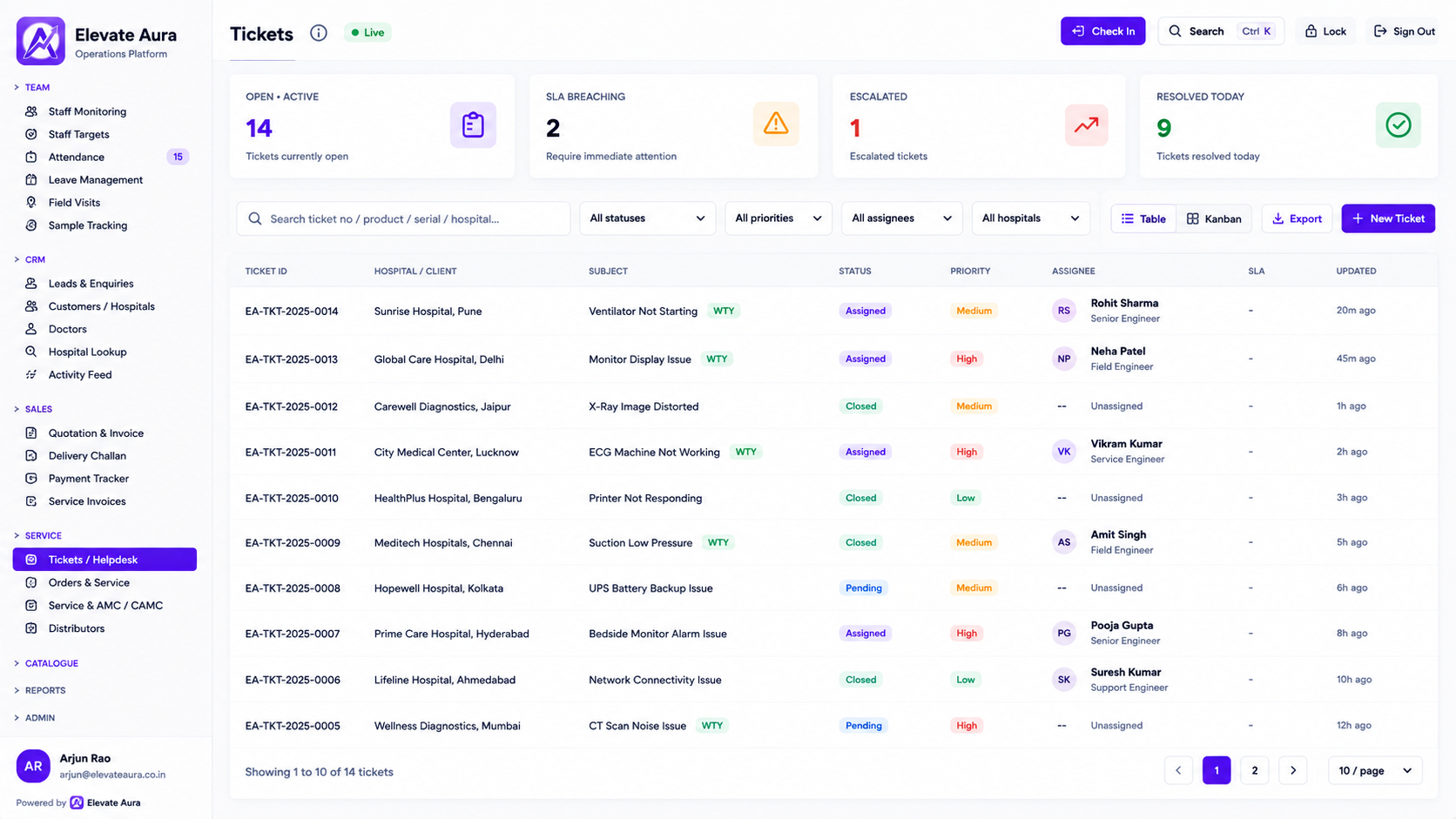
Aura Business customer list showing hospital accounts, key contacts, territory and pipeline stage
In one sentence

What medical device CRM software is built to do

Medical device CRM software manages the relationships a manufacturer sells through: the doctors who influence a purchase, the biomedical and purchase staff who approve it, the reps who visit them, and the dealers who carry the product into territories the manufacturer does not cover directly. Aura Business is that CRM plus the operations behind it, so a demo unit on loan, a dealer's order, and the serial number that ends up installed are all one connected record.

A distributor's CRM asks 'who bought'. An OEM's CRM has to also ask 'which dealer sold it, which doctor asked for it, where is the demo unit, and is the installed base in that territory growing'. That second set of questions is what this page is about.

The OEM's problem

Selling through dealers means the customer is two steps away.

The manufacturer funds the demo units, the samples and the rep's travel, and then learns about the sale from a dealer's purchase order weeks later, if at all.

Doctors known only to the rep

The surgeon who champions your product is in the rep's phone, and leaves with the rep.

Demo units unaccounted for

A device sent to a hospital for evaluation stays there for months, with nobody sure whether it was bought, returned or lost.

Territories without numbers

Targets are set by state, but pipeline and installed base are not, so the review is opinion.

Dealer orders by email

Dealers order on WhatsApp and pay by bank transfer, and someone matches UTRs to orders by hand.

Installed base unknown

You do not know how many of your units are running in a city, which limits service planning and upgrade sales.

Dealer and direct overlap

A direct rep and a dealer chase the same hospital, and the discount war is with yourself.

How an OEM sale runs

From the doctor's interest to a serial in the installed base.

01

Account and contacts

The hospital account holds the clinical champion, biomedical head and purchase officer.

→
02

Visit and demo

The rep logs a GPS-checked visit; a demo unit or sample is issued and tracked.

→
03

Quote

Direct quote from the builder, or the dealer quotes with your price list.

→
04

Order

Direct sales order, or a dealer order through the portal with UTR payment.

→
05

Deliver and install

Challan, e-way bill, installation and acceptance sign-off.

→
06

Installed base

The serial enters the register with the dealer, hospital, warranty and territory.

What is included

CRM, dealer, and installed-base modules for a manufacturer.

🤝Relationships

  • Customer and hospital accounts
  • Contacts and decision-makers, including doctors
  • Leads and pipeline
  • Field visits with GPS check-in
  • Activity feed and rep log

📦Demos, samples and territory

  • Sample tracking for units on loan
  • Territory and target management
  • Lead-source and conversion analytics
  • Brand and authorisation per dealer

🏢Dealer network

  • Distributor and B2B order portal
  • Distributor payment by UTR
  • Order tracking page for dealers
  • Branded login and docs vault
  • Supplier price lists as dealer price lists

📋Installed base

  • Asset and installed-base register per serial
  • Warranty tracking
  • Service history per asset
  • Reports by dealer, territory and product line

See all 87 modules across 12 suites →

In practice

What a device company can finally answer.

Where is every demo unit

Workflow: Each demo device is issued against a hospital and a rep with a return date; the sample tracker lists units out, overdue and converted.

Result: Demo stock comes back or turns into an order, not into a loss.

Which dealer is growing the base

Workflow: The installed-base register carries the dealer on every serial, and the report groups new installations by dealer and quarter.

Result: Dealer reviews use installations, not promises.

A dealer orders and pays without a phone call

Workflow: The dealer logs into the portal, orders from the authorised price list, uploads the UTR, and follows the order on the tracking page.

Result: Orders and payments reconcile themselves.

The champion doctor stays with the company

Workflow: Contacts, visit notes and sample history live on the account, not in the rep's phone.

Result: A rep leaving does not take the relationship with them.

Who it is for

Manufacturers and OEMs with a channel to manage.

🤖
Device manufacturers

Monitors, surgical devices, robotics, diagnostics hardware.

🏭
Importers acting as OEM

National distributors with sub-dealers by state.

🔬
IVD and lab equipment makers

Analysers placed on reagent-rental and sold through dealers.

👨‍💼
Founder-led medtech

First product, first ten dealers, no CRM yet.

⚙
Industrial equipment OEMs

The same dealer model outside healthcare.

The honest comparison

A sales CRM, an ERP, or an OEM platform.

 
Generic CRM
Enterprise ERP
Aura Business
Doctors and decision-makers
Contacts
Not a focus
Roles per hospital account
Demo and sample units
Not modelled
Stock transfer
Sample tracker with return dates
Dealer ordering
Not included
Complex portal projects
Portal with price list, UTR, tracking
Installed base
Not included
Asset module, if bought
Register per serial with dealer and warranty
Territory targets
Basic
Yes
Targets against pipeline and installations
Time to live
Weeks plus customisation
Months
30 working days where scope allows
Proof

Platforms we have actually shipped.

Questions

Medical device CRM, answered.

How is a medical device CRM different from a medical equipment distributor CRM?

A distributor sells other people's products to hospitals. A manufacturer also sells through dealers, lends demo units, manages territories and needs to see its installed base regardless of who sold it. Aura Business covers both; this page is the manufacturer's view. See medical equipment CRM software for the distributor's.

Can doctors be recorded as influencers without being buyers?

Yes. The Contacts and Decision-Makers module records people by role on a hospital account, so a surgeon can be the clinical champion while the purchase officer is the commercial contact, and visits are logged against either.

How are demo units and samples tracked?

The sample tracking module issues a unit against a hospital and a rep with an expected return date, and shows units out, overdue, returned and converted to sale. Demo stock is held as its own stock location in inventory.

What does the dealer see in the portal?

Dealers log into a branded portal to order from the price list authorised for them, upload UTR references for payments, follow orders on the tracking page, and download documents from the vault. See dealer management software.

Can I see the installed base by dealer or territory?

Yes. Every serial in the installed-base register carries its dealer, hospital and territory, and the reports engine groups installations, warranty status and service history by any of those.

Has Elevate Aura built for a device company before?

Yes. Medline Robotics, a medical robotics company in Chennai, runs a storefront, distributor portal, quotations, distributor ordering and UTR verification built by Elevate Aura. See the Medline Robotics case study.
Keep exploring

Related Aura Business software

Let's talk about your requirement.

Tell us how you work today. We will show you what the platform would look like for you, and give you a clear scope and timeline.

Founder-led · Chennai, India · Built and supported by the person who wrote it