HIMS gives the ward its own working view of the patient record: vitals and nursing charts against each bed, tasks raised by doctor orders, what was administered and when, and a handover the next shift can actually read.

Nursing in HIMS is not sold as a separate product. It is the ward-facing half of the same patient record the doctor writes in: the nurse opens the bed, sees the orders raised that morning, records vitals and observations on the chart, notes what was administered, and leaves a handover entry for the next shift. Everything lands on the admission, not on a clipboard that stays at the nurses station.
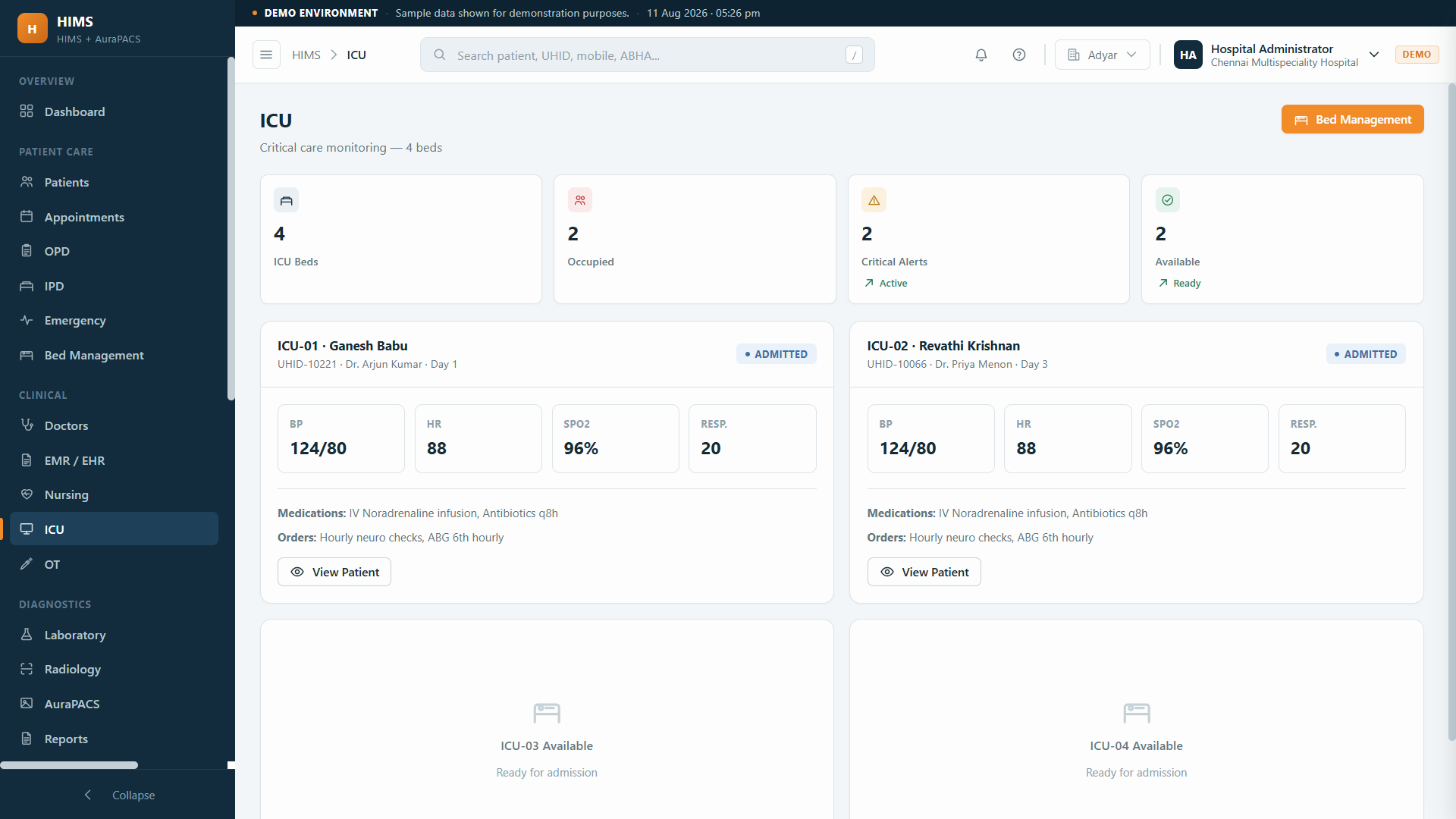
That single-record design is the whole point. When a consultant changes a drug at eleven in the morning, the ward sees the change the moment it is written. When the shift turns over at eight, the incoming nurse reads what the outgoing nurse recorded rather than what she remembers. In ICU the same chart carries live vitals per bed, so the sickest patients are documented in the same structure as the rest of the hospital.
Nursing is usually the best documented part of a hospital and the least shared.
A drug or an investigation is changed during the round and reaches the ward as a spoken instruction with nothing written behind it.
Vitals sit on a folder hanging off the cot, so the doctor at home cannot see the trend.
Shift change happens in a corridor. What was pending, what was refused and what is due in an hour gets passed along verbally.
The dose is administered on time and written up later, so the record and the pharmacy issue slip disagree at discharge.
A week of nursing observations never reaches the summary because it was never in the system.
The bed view shows every occupied bed, the patient on it and what is due.
The previous shift's entries are on each admission, in order.
Drug, investigation and observation orders written by the doctor appear against the patient.
Vitals, intake and output and observations are recorded on the nursing chart.
What was given, when and by whom is logged against the patient, not on a loose sheet.
The closing note goes on the record and the next shift opens it, not a notebook.
Workflow: The consultant edits the prescription on the record and the ward sees the new order against that bed straight away.
Result: Nobody works from a verbal instruction.
Workflow: The outgoing nurse closes her entries and the incoming nurse opens the same admissions with the handover already written.
Result: The corridor briefing stops being the record.
Workflow: He opens the patient and reads the vitals charted through the evening before walking up to the ward.
Result: He arrives already knowing the picture.
Workflow: The summary is written from a record that already holds a week of nursing charts and administration entries.
Result: Nothing has to be reconstructed.
Several wards, several shifts, one chart standard.
Small teams where the handover cannot depend on one person.
Live vitals per bed in the same structure as the wards.
A readable trend before walking to the bed.
Nursing documentation that is attributed and timed.
No. Nursing workflows are part of the clinical record in HIMS, alongside the doctor's side of it. The ward gets its own view of the same admission rather than a second system to log into. See the hospital management system page.
Yes. Vitals and observations are charted against the patient occupying the bed, and in ICU the same structure carries live vitals per bed. The ward view shows which beds are occupied and by whom.
Orders written in the record, including the e-prescription, appear against the patient in the ward, so nursing works from the written order rather than an instruction passed on during the round.
What was administered is recorded against the patient with the time and the user who entered it, on the same record the prescription sits on. The pharmacy side of the drug, dispensing and stock, is handled in the pharmacy module.
Nursing entries are structured, attributed and timed, which is what NABH-style documentation asks for. The accreditation decision itself rests with the assessing body and looks at how your hospital works, not at which software produced the notes.
The ward view is built around beds rather than menus, so charting a round is a short sequence of entries. Training at your own front desk and ward is part of the setup, and the system is scoped to go live in 30 working days where scope allows.
Tell us how you work today. We will show you what the platform would look like for you, and give you a clear scope and timeline.
Founder-led · Chennai, India · Built and supported by the person who wrote it