HIMS shows every ICU bed with its patient and live vitals, keeps the critical-care nursing chart and doctor orders on the admission record, and treats step-up and step-down as ordinary transfers on the hospital's bed board.

ICU management software gives the critical-care unit its own view of the hospital record: each bed with its patient, live vitals per bed, the nursing chart for the shift, the intensivist's orders and the status of the bed itself. In HIMS this is a module of the inpatient system rather than a separate application, so an ICU stay is part of the same admission that started in casualty or the ward.
The ICU differs from a general ward in the density of documentation. Vitals are recorded far more often, medication and infusion changes are frequent, and orders change by the hour. The ICU screen in HIMS is built around that density, while everything it records still lands on the one patient record that the ward, the pharmacy, billing and the discharge summary read.
A bedside flow sheet is complete for the shift and invisible to everyone outside the unit.
The consultant reviewing from the OPD, the ward receiving the step-down and the TPA desk all need what is on that sheet.
An infusion rate is changed on a round; the change reaches the chart an hour later, or not at all.
Casualty asks if there is an ICU bed; the answer depends on who picks up the phone.
Ventilator days, infusions and monitoring charges are billed at discharge from whatever the file shows.
The patient moves to the ward with a summary and the ICU chart stays behind.
From casualty, OT or a ward transfer; the ICU bed is allocated on the board.
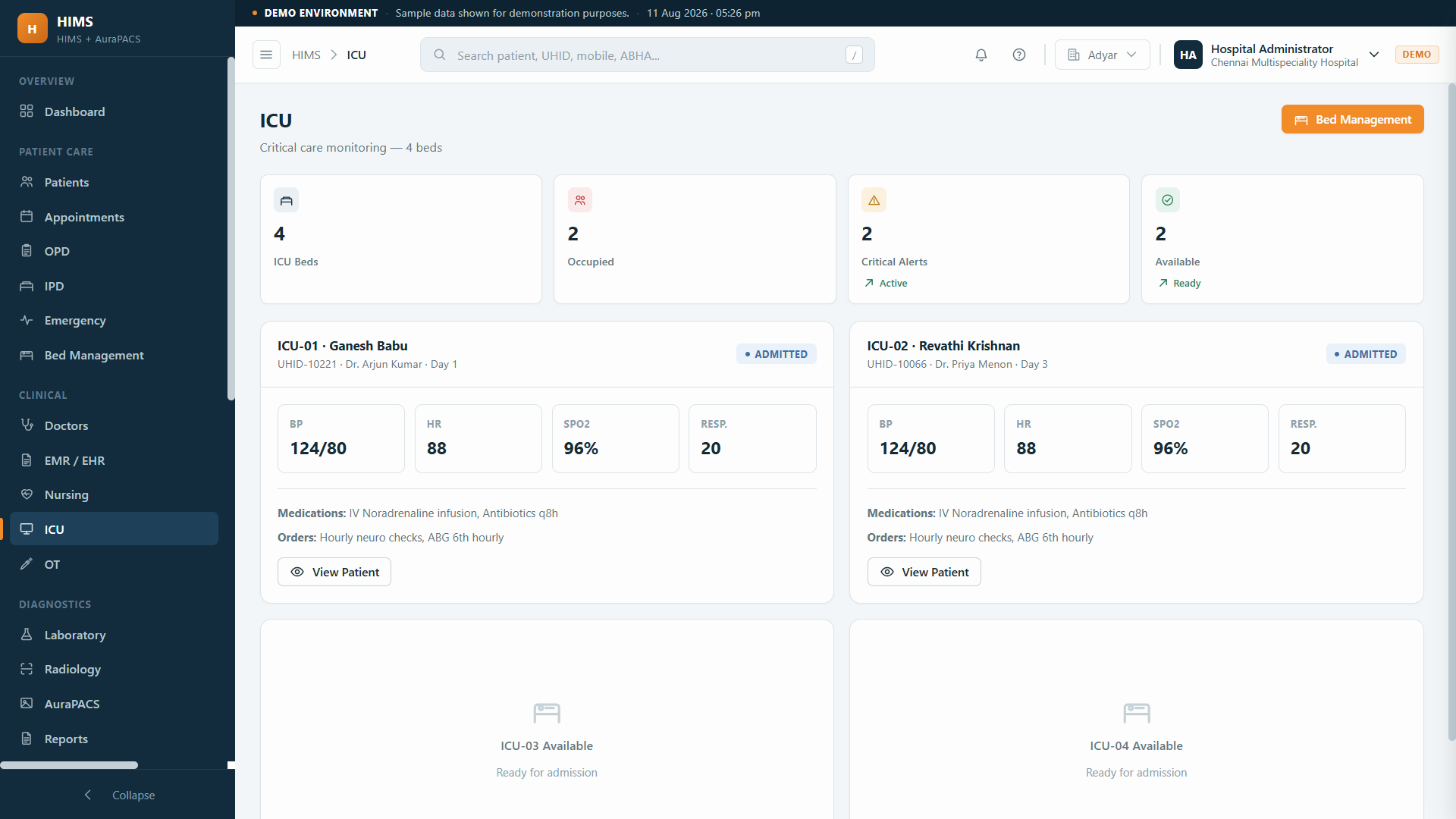
Live vitals shown against the bed on the ICU screen.
Intensivist orders drugs, infusions and investigations on the record.
Critical-care chart, medication administration and notes per shift.
ICU bed days, procedures and consumables post to the IP bill.
Transfer to the ward; the ICU bed frees and the record continues.
Workflow: The triage board shows a patient needing critical care; the bed board shows one ICU bed free and the transfer is made on the record.
Result: No phone call to confirm the bed.
Workflow: The consultant opens the record from the OPD and reads the overnight chart, the vitals and the current orders.
Result: The review does not wait for a printed sheet.
Workflow: ICU days accrue on the running bill; the TPA desk raises an enhancement against the same admission with the chart as evidence.
Result: The approved amount keeps up with the stay.
Workflow: The transfer moves the patient to a ward bed; the ICU chart and orders remain on the record for the ward team.
Result: The ward starts from the history, not from a summary.
ICU, HDU and post-operative care on one board.
A few critical beds that must be documented well.
Orders and charts on the record, not on a clipboard.
A chart built for hourly entries.
Documentation available without visiting the unit.
The ICU screen in HIMS shows each bed with its patient and the current vitals recorded against that bed, as shown in the hospital demo. How vitals reach the screen in your unit, from your monitors or from nursing entry, is confirmed on the call for your equipment.
Yes. The critical-care nursing chart is built for frequent entries: vitals, infusions, medication administration and notes per shift. It sits on the same admission record as the ward chart, so the history is continuous.
Yes. ICU beds are part of the hospital bed board, so the triage desk sees occupied and free critical-care beds without calling the unit. See emergency department software.
ICU bed days, procedures, consumables and drugs post to the running IP bill as they happen, and an interim statement can be printed for the family or the TPA at any point.
The ICU chart, orders and notes are structured to support NABH-style documentation. Accreditation is assessed against your unit's processes by the accrediting body; the software gives you the record.
No. It is a module of the inpatient system and shares the record, the pharmacy, the laboratory and billing. See hospital IPD software for the admission side.
Tell us how you work today. We will show you what the platform would look like for you, and give you a clear scope and timeline.
Founder-led · Chennai, India · Built and supported by the person who wrote it