← Elevate Aura  ·  HIMS & AuraPACS clinical software Chennai, India · WhatsApp
For casualty and trauma teams

Emergency department software with a live casualty triage board and one-step admission.

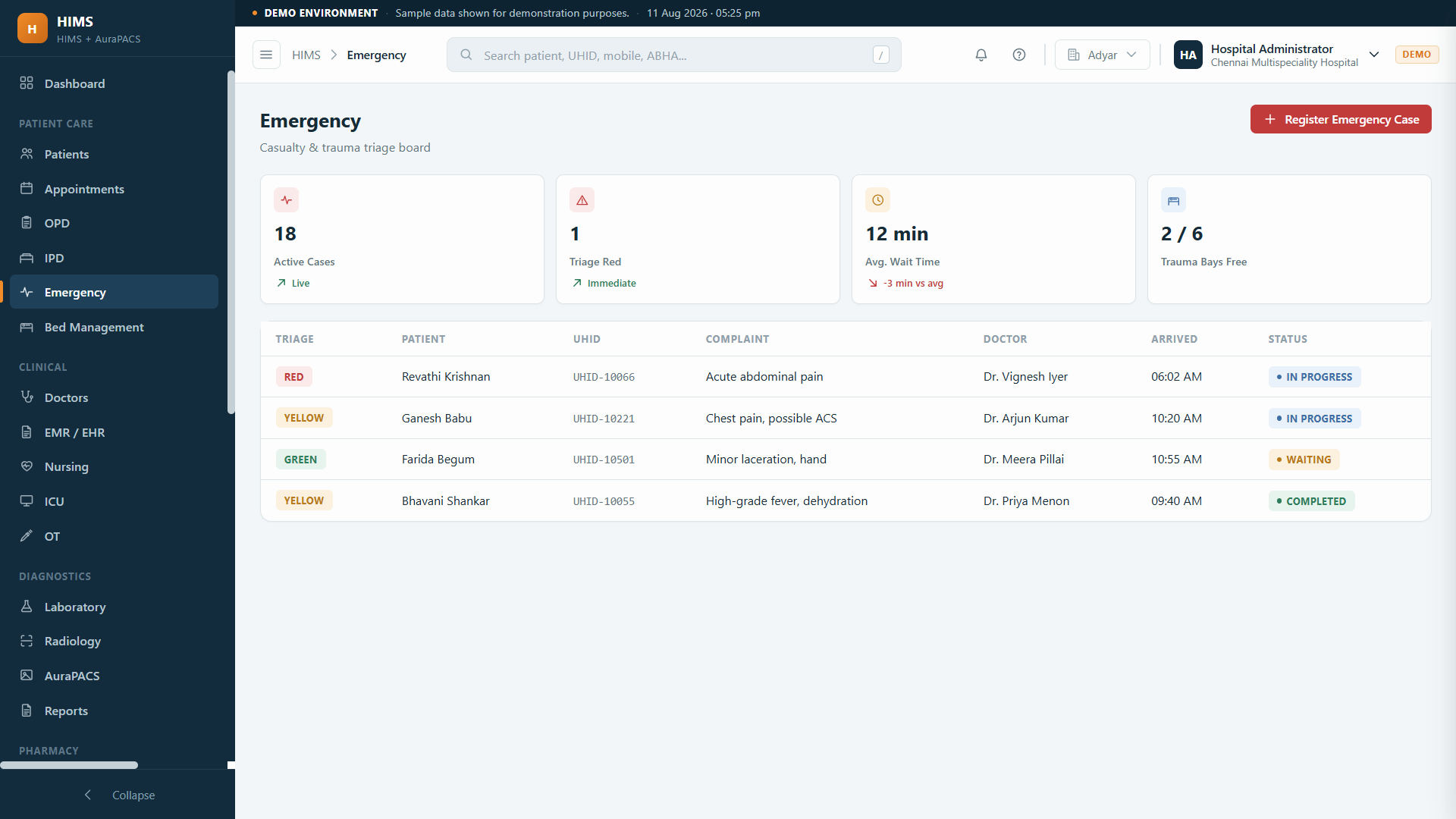
HIMS runs casualty on a live triage board: patients are registered in seconds, placed in a bay with a triage category and status, ordered for and treated from the board, and either discharged from casualty or converted into an inpatient admission on the same record.

Live triage board with category and statusRegistration in seconds, details laterCasualty to IP admission in one step
his.elevateaura.co.in/emergency
HIMS emergency screen showing the casualty and trauma triage board with patient status
In one sentence

What emergency department software does

Emergency department software runs the casualty area of a hospital from the moment a patient arrives: a fast registration that can be completed later, a triage category, a place on a live board showing every patient in the department and their status, orders and treatment from that board, and a clean exit either to discharge or to an inpatient bed. In HIMS the casualty and trauma triage board is a module of the same platform that runs OP, IP and billing.

The design principle is that casualty cannot wait for paperwork. The board comes first; demographics, payer details and consent follow once the patient is stable. Because the casualty record is the hospital record, an admission from casualty carries its investigations, drugs and notes straight into the ward, the ICU or the operation theatre.

Why casualty runs on memory

The busiest department in the hospital is usually the least documented.

Nobody has time to write in casualty. So the record is built afterwards, or not at all.

Registration blocks treatment

The desk needs a name, an address and a payer before a file exists, and the patient is on a trolley in the corridor.

No one can see the whole bay

The medical officer knows the cases they have seen. The in-charge does not know how many are waiting or who has been there longest.

Orders shouted, not recorded

Investigations and drugs given in casualty are written up later from memory, if at all.

Admission starts again

The patient reaches the ward and the admission is registered afresh, losing the casualty notes.

Casualty charges vanish

Drugs, dressings and procedures done in casualty rarely make it onto the bill.

One casualty case

From arrival to the ward.

01

Fast registration

Name or unknown patient, a UHID and a bay, in seconds.

→
02

Triage

Category assigned and the patient appears on the live board.

→
03

Orders and treatment

Investigations, imaging and drugs ordered from the board against the record.

→
04

Status updates

Waiting, under treatment, awaiting results, ready for decision.

→
05

Decision

Discharge from casualty, or convert to an IP admission with a bed.

→
06

Details completed

Demographics, payer and consent finished once the patient is stable.

What is included

The casualty module and its connections.

🚑Triage board

  • Live board of every patient in casualty
  • Triage category and bay
  • Status per patient
  • Time since arrival

👤Registration

  • Fast registration with minimal fields
  • Unknown patient handling
  • Details completed later
  • Existing patients found by UHID or phone

💊Clinical

  • Orders to lab, AuraPACS and pharmacy
  • Casualty notes on the EMR
  • Drugs and consumables against the case
  • Supports NABH-style documentation

🛏Onward

  • Convert to IP admission in one step
  • Free beds and ICU beds visible from casualty
  • OT list for emergency surgery
  • Casualty charges on the bill

See what happens after admission →

In practice

What changes in casualty.

A road accident at night

Workflow: Registered as an unknown patient in a bay, triaged red, imaging ordered to AuraPACS from the board; details added when relatives arrive.

Result: Treatment starts before the paperwork.

A chest pain that needs the ICU

Workflow: The medical officer sees a free ICU bed on the board and converts the casualty record into an admission with that bed.

Result: The ICU receives the record, not a verbal handover.

A minor injury treated and sent home

Workflow: Dressing and injection recorded against the case, discharged from casualty with the bill raised from what was done.

Result: Casualty revenue is captured.

A crowded evening

Workflow: The in-charge sees eight patients on the board, two waiting longest, and reassigns the second medical officer.

Result: Waiting is managed from a screen, not from noise.

Who it is for

Any hospital that receives emergencies.

🏥
Multi-specialty hospitals

A casualty that feeds every department.

🏞
Nursing homes

A small casualty with one medical officer.

👨‍⚕️
Casualty medical officers

A board instead of a register.

👩‍⚕️
Emergency nursing

Orders and drugs recorded as given.

📊
Administrators

Casualty load and admissions on the dashboard.

The honest comparison

Running casualty, three ways.

 
Paper registers and Excel
Standalone billing software
HIMS by Elevate Aura
Registration
Full form before a file exists
Bill header only
Seconds, details later
Who is in the department
Casualty register
Not covered
Live triage board with status
Orders from casualty
Verbal, written later
Not covered
To lab, imaging and pharmacy from the board
Admission
New file on the ward
New bill
Same record, one step
Casualty charges
Mostly lost
Typed from memory
Raised from what was recorded
Questions

Emergency department software, answered.

Can a patient be registered without full details?

Yes. Casualty registration needs only enough to create a UHID and a place on the board, including an unknown patient. Demographics, payer and consent are completed once the patient is stable, on the same record.

What does the triage board show?

Every patient currently in casualty with their bay, triage category, status and time since arrival, so the in-charge sees the department at a glance. It is the same board shown in the hospital demo.

How does a casualty case become an admission?

The medical officer converts the casualty record into an IP admission and picks a free bed, including ICU beds, from the bed board. Everything ordered and given in casualty is already on the admission. See bed management.

Can imaging be ordered from casualty?

Yes. An imaging order goes to AuraPACS, the study lands from the machine and the images open in the browser viewer on the patient's record, so the casualty team and the radiologist see the same study.

Are casualty charges billed?

Drugs, consumables and procedures recorded against the casualty case are raised on the bill, whether the patient is discharged from casualty or admitted. See hospital billing software.

Is the emergency module part of HIMS?

Yes. It is one module of the hospital platform and shares the record with OP, IP, ICU, OT, pharmacy, laboratory and billing. Read the hospital management system page for the whole picture.
Keep exploring

Related HIMS modules

Let's talk about your requirement.

Tell us how you work today. We will show you what the platform would look like for you, and give you a clear scope and timeline.

Founder-led · Chennai, India · Built and supported by the person who wrote it