A day care unit admits, treats and discharges between morning and evening, often several times over on the same chair or bed. HIMS runs that as a real admission with a real record, and bills it as the package it was quoted as.

Day care sits awkwardly between the two workflows most hospital systems are built around. It is more than an outpatient consultation, because the patient occupies a place, receives a procedure or an infusion and is observed. It is less than an inpatient stay, because there is no overnight and the same chair or bed may take two or three patients before the unit closes. Treated as OP it loses the record; treated as IP it clogs the ward view.
HIMS handles it as a short admission. The patient is admitted under their existing UHID, given a place in the unit, treated and discharged the same day, with the clinical record, the drugs and consumables used and the observations all on that episode. Billing then works the way day care is actually sold, as a package covering the procedure rather than a list of departmental charges the patient never agreed to.
The episode is over in hours, which is exactly why nobody documents it properly.
A procedure with observation is squeezed into a consultation entry, so the record does not reflect what happened.
Who is in which chair and when it frees up lives on a board that only the unit can see.
Someone coming twice a week is registered again each time and the history never accumulates.
What was used during the session is drawn from stock informally and never reaches the bill.
The session was quoted as a package and billed as separate items, so discharge becomes a negotiation.
The session is booked against the patient's UHID, with reminders if you use them.
A short admission is created and a place in the unit is allocated.
The procedure, drugs given and observations are recorded on the episode.
Items used come from pharmacy and stores stock against this patient.
The patient leaves the same day and the place shows as free.
The package is billed as one item, with anything outside it shown separately.
Workflow: The morning session is discharged, the place shows free and the afternoon patient is admitted to it.
Result: Turnaround is visible rather than remembered.
Workflow: Each session is an episode on the same UHID, so the sequence of treatments reads as one history.
Result: The doctor sees the course, not a single day.
Workflow: The admission is created on the package and departmental charges resolve into it at discharge.
Result: The bill matches the quote.
Workflow: The approved portion and the patient balance sit on the same bill, with documents drawn from the episode.
Result: The claim describes what actually happened.
Procedures and observation without an overnight.
Recurring sessions on a schedule.
A day care wing beside the wards.
More than a consultation, less than an admission.
Packages that hold up at discharge.
It is handled as a short admission, which is what keeps the clinical record, the consumables and the observations attached to the episode. The patient is admitted and discharged on the same day rather than being recorded as a consultation.
No. HIMS does not carry specialty-specific modules, and it would be dishonest to claim one. What it does have is the generic short-stay flow described here: scheduled sessions, a place in the unit, the record, consumables and package billing. Tell us how your unit runs and we will say plainly what fits.
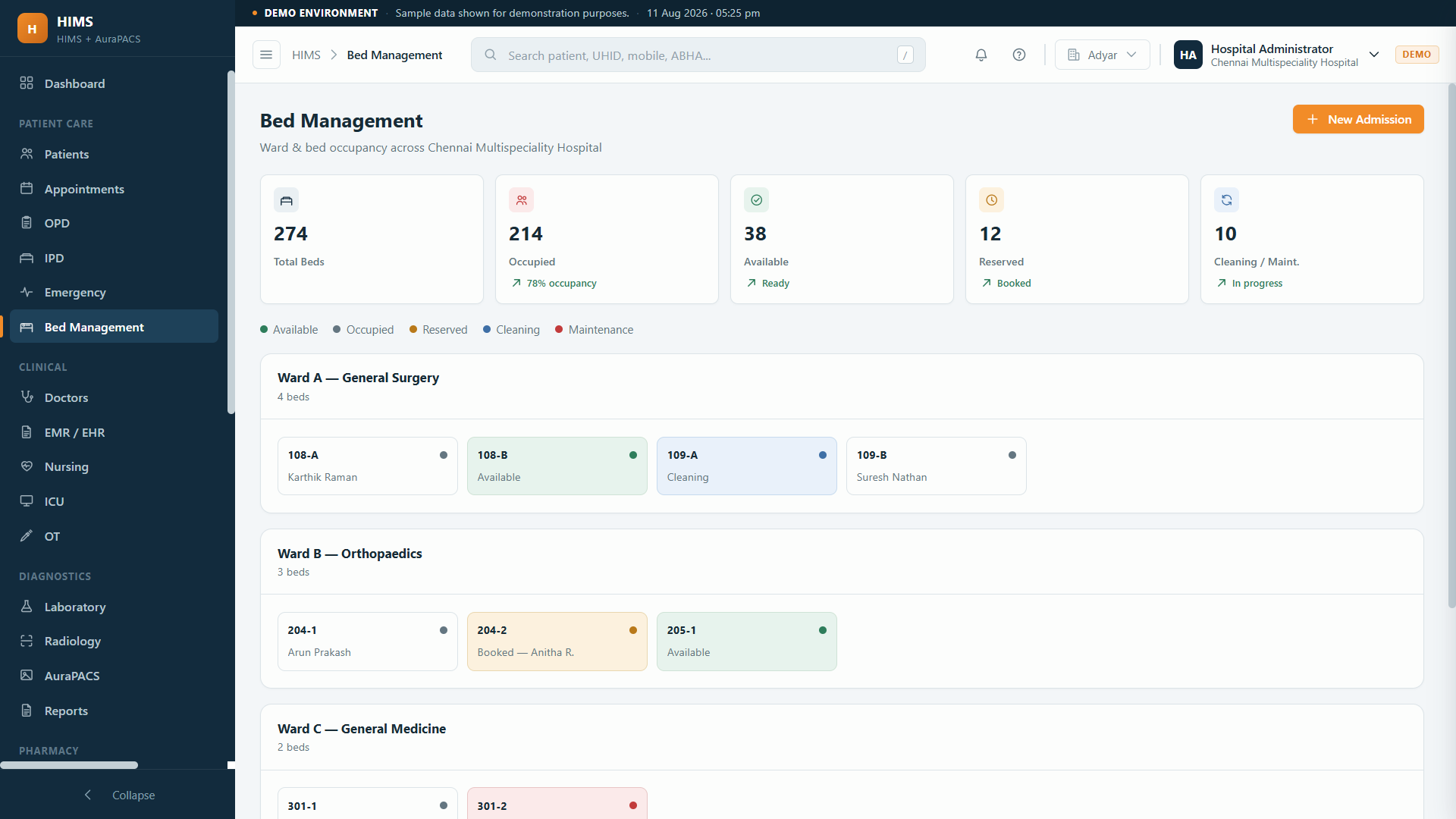
Yes. Places in the day care unit are tracked the way ward beds are, so the unit can see what is occupied and what has freed up as sessions finish. See bed management.
Every session is an episode under the same UHID, so a patient attending regularly builds one continuous history rather than a series of unrelated entries. See UHID registration.
Yes. The package is defined with its inclusions and billed as one item, with anything outside it shown separately. Read package billing software for how inclusions are set up.
Yes. Day care is part of the same platform as the wards, the theatre and OP, so a hospital with a day care wing runs both on one patient record rather than two systems.
Tell us how you work today. We will show you what the platform would look like for you, and give you a clear scope and timeline.
Founder-led · Chennai, India · Built and supported by the person who wrote it