Every patient in HIMS gets one unique hospital identification number at first contact. That UHID is what OP, the ward, the pharmacy, the laboratory, imaging and billing all work against, so the same person is never two records.

A UHID is the unique hospital identification number a patient is given the first time they walk in. It is not a case number for that visit and not an admission number for that stay. It belongs to the person, and every visit, admission, prescription, laboratory order, imaging study and bill afterwards hangs off it. In HIMS the UHID is created at registration and never created again for the same person.
This is the least glamorous module in a hospital system and the one everything else depends on. If a patient can end up with three identification numbers, then the history is split three ways, the follow-up doctor sees a third of the story, and the outstanding on one of the three is invisible. Getting registration right is what makes a single patient record possible at all.
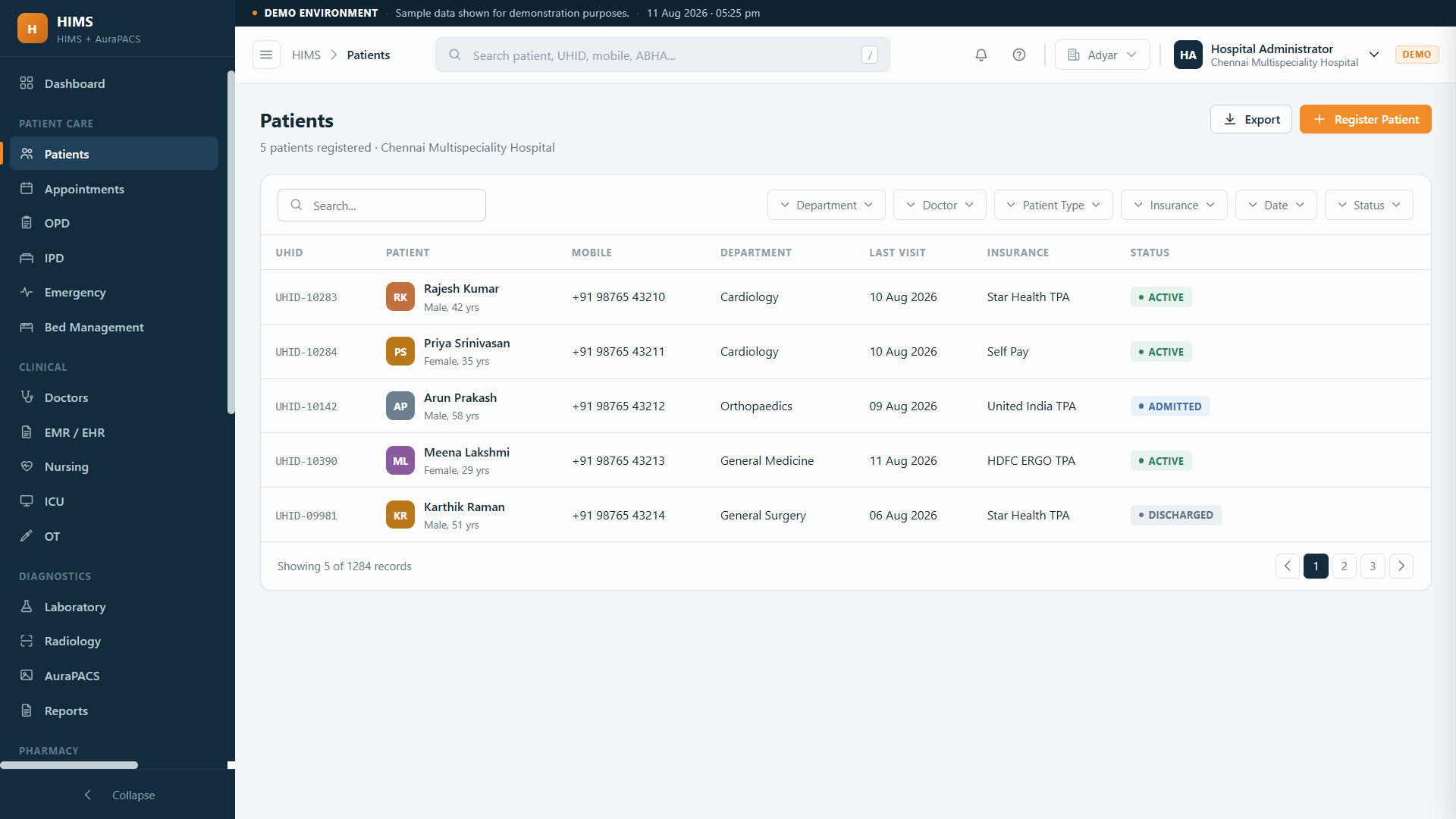
Registration takes twenty seconds and decides whether the record is usable for the next decade.
When searching is slower than typing, the counter creates a fresh entry and the history starts again.
The same person is entered three ways across three visits and no search will ever bring them together.
The outpatient file and the admission file carry different numbers and nobody links them.
Laboratory and pharmacy maintain their own numbering, so the same patient exists differently in each.
A returning patient's previous reports exist somewhere but cannot be found in time to be useful.
The counter looks for the patient by phone number or name before anything is created.
If they are already registered, the visit is added to the UHID they already hold.
If they are genuinely new, demographics are captured once and a UHID is issued.
An OP token or an IP admission is created against that UHID, not beside it.
Pharmacy, laboratory, imaging and the wards all act against the same number.
Every charge and every payer, cash, TPA or corporate, sits under the same patient.
Workflow: The counter finds them on a phone number search and the doctor opens a history that is already there.
Result: The consultation starts informed.
Workflow: The admission is created against the same UHID, so the morning's consultation and the ward notes are one record.
Result: Nothing is retyped at admission.
Workflow: The verified result posts to the UHID, so it is on the record whichever department ordered it.
Result: No printouts carried between counters.
Workflow: Previous studies are found under the same patient rather than by date and machine.
Result: The comparison happens in the reporting room.
One identity across every department.
Shared front desk, several doctors, one record.
Repeat patients with comparable history.
OP and IP on the same number.
A search that is faster than retyping.
The unique hospital identification number issued to a patient at first contact. Visits, admissions, prescriptions, laboratory orders, imaging studies and bills all attach to it, which is what allows one continuous record instead of a file per visit.
Registration begins with a search on phone number or name, so the counter is shown existing patients before a new UHID is created. Making the search quicker than retyping is what actually prevents duplicates at a busy desk.
Yes. An admission is created against the existing UHID rather than as a separate identity, so the OP consultation that led to the admission and the ward notes afterwards sit on one record. See IPD software.
Your existing patient data is migrated in during setup, so returning patients are found rather than re-registered. Records that were already duplicated in the old system are the ones to clean before migration.
They are different things. The UHID is your hospital's own identifier for the patient. HIMS is built to support ABHA linking and ABDM-aligned workflows alongside it. Read what ABHA and ABDM ready means.
Yes. It is given at registration and is how the patient is identified at every counter afterwards, including in the patient portal where their reports are visible.
Tell us how you work today. We will show you what the platform would look like for you, and give you a clear scope and timeline.
Founder-led · Chennai, India · Built and supported by the person who wrote it