← Elevate Aura  ·  HIMS & AuraPACS clinical software Chennai, India · WhatsApp
For orthopaedic hospitals and surgical centres

Orthopaedic hospital software where the theatre and the implant store decide the day.

Orthopaedic work is planned surgery with expensive stock inside it. HIMS runs the theatre list, issues implants and consumables against the case, puts them on a package or TPA bill, and keeps the follow-up visits months later on the same record.

Implants issued against the caseTheatre lists and package billingFollow-up on the same record
his.elevateaura.co.in/inventory
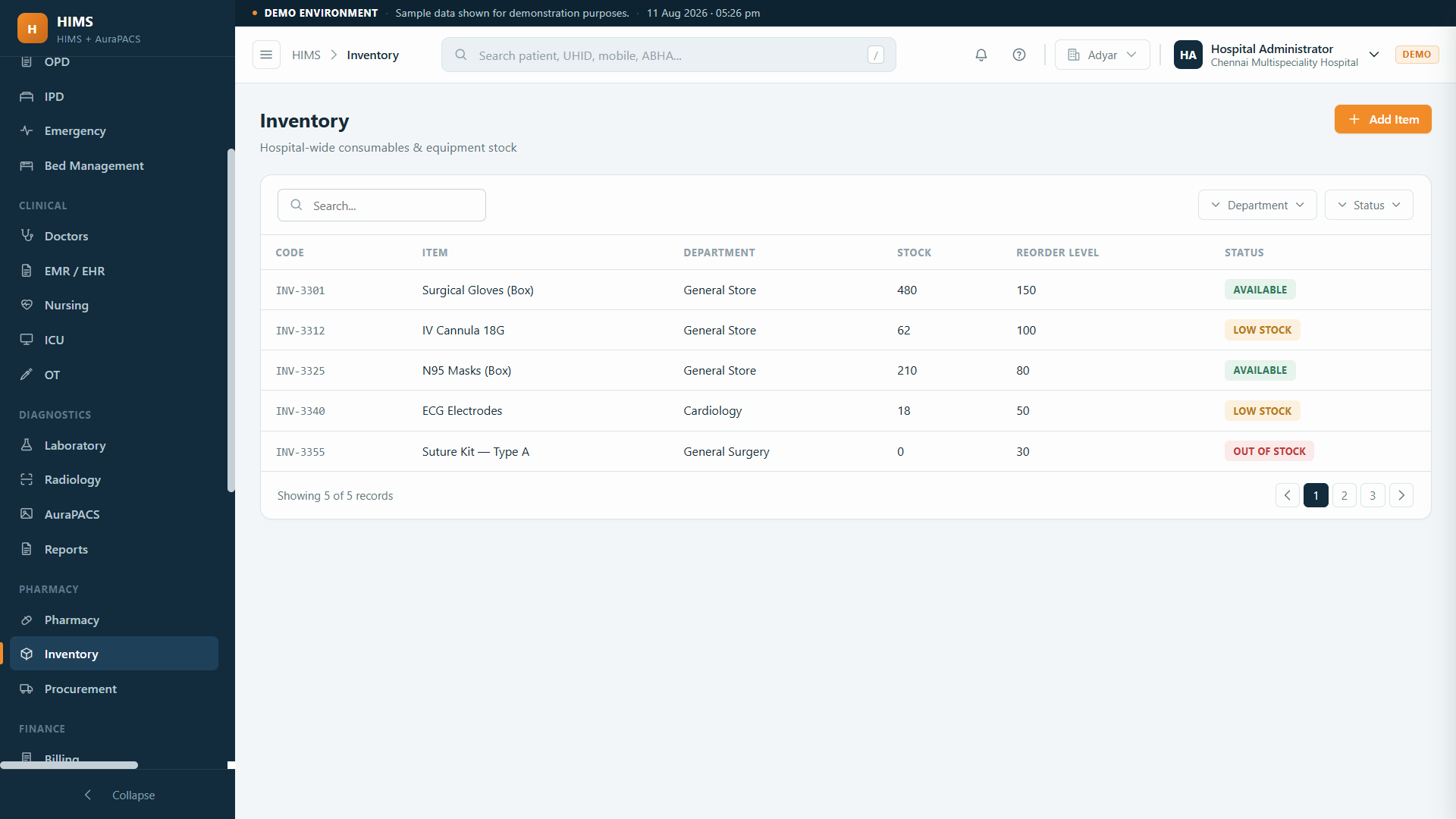
HIMS inventory view showing stock items, reorder levels and issues against a case
In one sentence

What an orthopaedic hospital needs a system to hold together

An orthopaedic hospital earns most of its money in the theatre, and a large part of each case is the implant. The theatre list has to be planned and kept, the implants and consumables used in a case have to leave stock and land on the bill for that case, the claim has to be prepared before the patient goes home, and the record has to still be there when the patient returns for review six months later.

HIMS covers this with operation theatre scheduling, inventory with reorder levels for implants and consumables, package billing for a procedure, insurance and TPA billing, and one patient record that carries the surgery and every later review. Implants are handled as high-value stock issued against the case. How far unit or lot-level tracking is taken for your particular implant sets is agreed during scoping rather than claimed on this page.
The theatre-and-stock problem

The most valuable item in the hospital is the one nobody can account for.

When implants are tracked on paper, the shortfall shows up in the stock count, not the bill.

Implants issued on trust

A set is opened in the theatre, one item is used, and what went back is recorded on a slip that reaches the store the next day.

The bill misses what the case used

Consumables opened during the procedure are remembered at discharge, and some of them are not.

The theatre list is a whiteboard

A cancellation frees a slot nobody knows about, and the surgeon's afternoon is spent waiting.

Pre-authorisation started late

Planned surgery gives you weeks of notice, and the claim still gets assembled on discharge day.

Follow-up loses the case

A review six months on opens a new file, and the operation notes are in a bundle somewhere.

Consultation to review

How a planned orthopaedic case runs on HIMS.

01

Outpatient consultation

The patient is registered under a UHID, imaging and investigations attach to the visit through AuraPACS and the laboratory.

→
02

Surgery planned

The case goes on the theatre list with the surgeon, the date and the expected procedure.

→
03

Payer settled first

Package, insurance or TPA is recorded and pre-authorisation is raised while there is still time.

→
04

Admission

Bed allocated, nursing charts opened, pre-operative orders on the record.

→
05

In theatre

Implants and consumables are issued against the case, so stock falls and the case carries the cost.

→
06

Ward and discharge

Post-operative notes, drugs from the pharmacy, summary and final bill against the package.

→
07

Review and physiotherapy

Follow-up appointments are booked, and a physiotherapy course is scheduled against the same patient.

What is included

The parts of HIMS an orthopaedic hospital uses hardest.

🧵Theatre

  • Operation theatre scheduling by surgeon
  • Planned lists and same-day additions
  • Pre-operative orders on the record
  • Procedure recorded against the admission

📦Implants and consumables

  • High-value stock in the inventory module
  • Issued against a case, not the ward
  • Reorder levels and low-stock alerts
  • Expiry alerts on sterile consumables

₹Billing for planned surgery

  • Package billing for a procedure
  • Implants billed on the same case
  • Insurance and TPA with pre-authorisation
  • Corporate and credit panels

📅After the surgery

  • Follow-up appointments from the discharge
  • Operation notes on the same record
  • Physiotherapy sessions against the patient
  • WhatsApp reminders for review dates

See theatre scheduling in HIMS →

In practice

What changes around the theatre.

A joint replacement case

Workflow: The implant is issued to the case in theatre, and the bill carries it without anybody retyping a code.

Result: Stock, case cost and bill agree at the end of the day.

The claim started early

Workflow: Pre-authorisation is raised when surgery is planned, not on discharge day.

Result: The family is not waiting at the counter for approval.

A review after six months

Workflow: The patient is found by phone number and the consultant opens the operation notes and imaging.

Result: The review starts from the case, not from memory.

Physiotherapy after discharge

Workflow: A course of sessions is booked against the same patient record and attendance is recorded per session.

Result: The hospital can see who completed rehabilitation and who stopped.

Who it is for

Hospitals built around a theatre.

🦴
Orthopaedic hospitals

Planned surgery as the main work.

🧵
Surgical centres

A theatre, a few beds and high-value stock.

🏥
Trauma units

Emergency cases that become admissions.

🧝
Hospitals with rehabilitation

Physiotherapy running after discharge.

👨‍⚕️
Surgeon-owners

Operating in the morning, owning the business.

The honest comparison

Running an orthopaedic hospital, three ways.

 
Paper registers and Excel
Standalone billing software
HIMS by Elevate Aura
Theatre list
Whiteboard
Not covered
Scheduled by surgeon and session
Implant stock
Store book and slips
Billed if remembered
Issued against the case, stock reduced
Cost of a case
Worked out later
Bill total only
Implants, drugs and procedure on the case
TPA for planned surgery
Started at discharge
Typed separately
Pre-authorisation raised when surgery is planned
Follow-up months later
A new file
A new bill
Same record, same operation notes
Questions

Orthopaedic hospital software, answered.

Is HIMS an orthopaedics product?

No. HIMS is a general hospital system configured for the way an orthopaedic hospital works, which is theatre-heavy planned surgery with high-value stock and long follow-up. It is not a specialty product, and anything specialty-specific is scoped on the call.

How are implants tracked?

Implants are held as stock in the inventory module and issued against the case, so the stock falls and the bill carries the item. The depth of unit or lot-level tracking for your implant sets is agreed during scoping rather than promised here.

Can a surgery be billed as a package with implants outside it?

Yes. A procedure can be billed as a package with implants and other items shown separately, so the patient and the payer see what is inside the package and what is not.

Does it handle TPA claims for planned surgery?

Yes. Pre-authorisation is recorded when the surgery is planned and claim documents come from the record at discharge. See TPA billing software.

Can we run our own physiotherapy unit on the same system?

Yes. A course of sessions is booked against the same patient record, so referral, attendance and billing stay with the surgical case. See physiotherapy clinic software.

Is imaging included?

AuraPACS is built into HIMS, so X-ray, CT and MR studies attach to the patient record and open in a browser viewer without a download. The read stays with your radiologist.

Keep exploring

Related HIMS pages

Let's talk about your requirement.

Tell us how you work today. We will show you what the platform would look like for you, and give you a clear scope and timeline.

Founder-led · Chennai, India · Built and supported by the person who wrote it