← Elevate Aura  ·  HIMS & AuraPACS clinical software Chennai, India · WhatsApp
For eye hospitals and vision centres

Eye hospital management software built for a very large outpatient day.

An eye hospital sees more patients in a morning than many hospitals see in a day, and each of them moves through several stations before the consultation. HIMS is configured around that path: registration, vision testing, dilation, consultant, theatre or optical counter, bill.

A queue built for several stationsOptical counter run as stockDay-case theatre on the same record
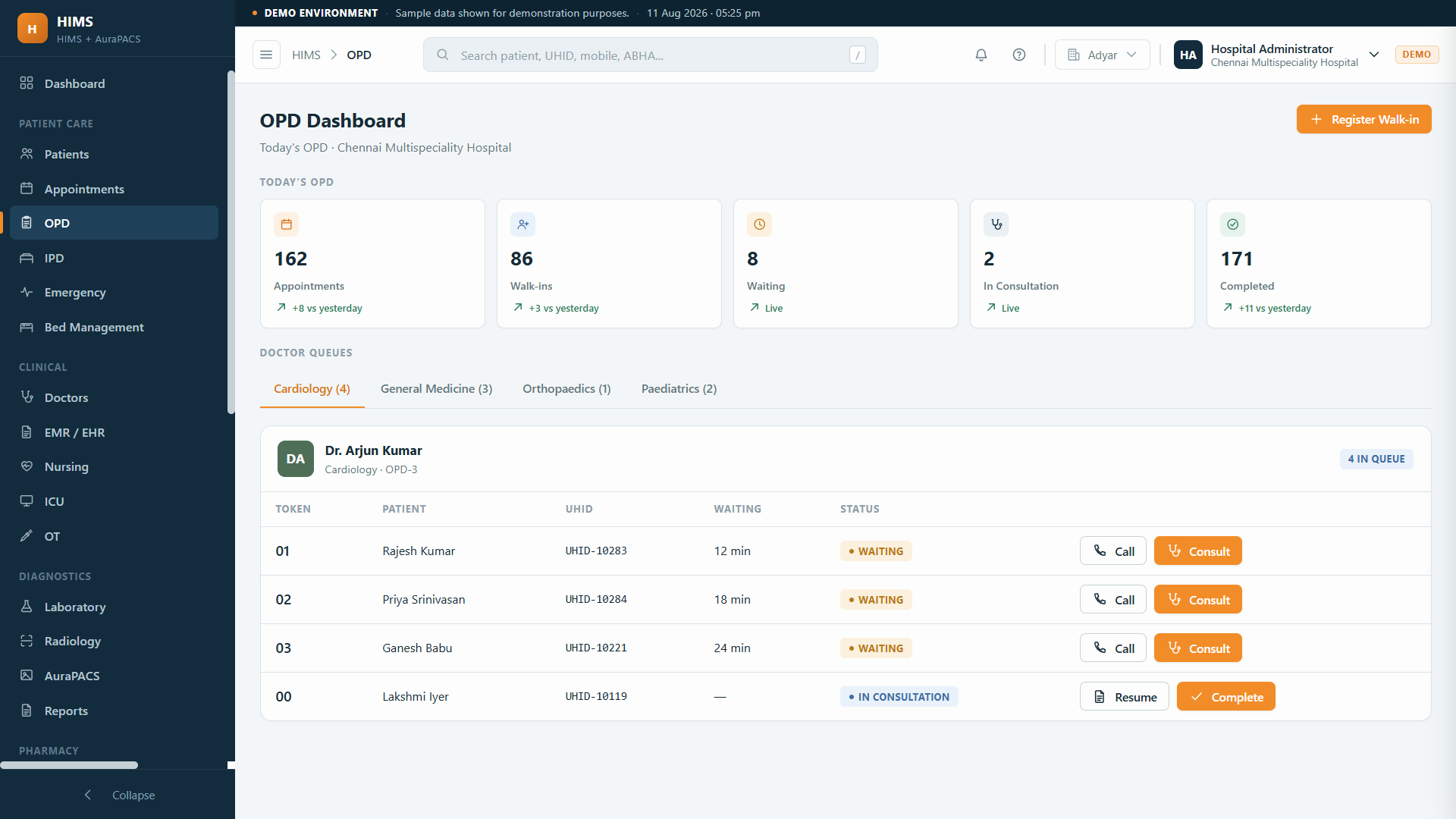
his.elevateaura.co.in/opd
HIMS outpatient dashboard showing the live token queue and waiting counts for the day
In one sentence

What an eye hospital needs from hospital software

Eye hospital management software has to survive volume. The consultation itself is short and often a repeat, but the visit around it is long, because the patient passes through registration, vision testing, drops and a wait, the consultant, and then either a day-case theatre or the optical counter. HIMS handles that as one patient record moving through a queue with several stopping points, so nobody is retyped at each station and nobody is lost between them.

The other thing that makes an eye hospital unusual is that it hands over goods as well as treatment. Frames and lenses behave like retail stock. HIMS treats the optical counter the way it treats the pharmacy counter: an item is issued against the patient, stock comes down, and the value lands on the same bill as the consultation. How far the optical side is taken is agreed during scoping.

The volume problem

Nothing in an eye hospital breaks quietly. It breaks in a corridor with eighty people in it.

The consultation is three minutes. Everything around it is where the day is lost.

The queue restarts at every station

A patient sent for drops comes back and argues about their place, because the only record of order was a paper token.

Refraction findings on a slip

The reading is written on paper, carried to the consultant and then carried again to the optical counter, where it is copied a third time.

The optical counter is a separate business

Frames sit in a stock book, sales sit in a second bill book, and nobody can say what one patient actually spent.

Theatre lists made the night before

Day-case lists are drawn up by hand, and a cancellation leaves a slot nobody fills.

One visit, several stations

How a high-volume eye outpatient day runs on HIMS.

01

Registration

A new patient gets a UHID; a review patient is found by phone number and keeps the same record.

→
02

Vision testing

The optometrist's findings are recorded against the visit rather than on a slip, and the consultant opens them.

→
03

Drops and the wait

The patient stays in the queue while dilating, so they return to their place instead of the back of the line.

→
04

Consultation

The consultant sees the visit with the testing already on it, records notes and raises an e-prescription.

→
05

Theatre or optical

A day case goes on the theatre list; a spectacle order goes to the optical counter.

→
06

Bill

Consultation, investigations, procedure and any goods issued settle on one bill, cash, insurance or TPA.

→
07

Review

The follow-up is booked before the patient leaves and lands on the same record.

What is included

The parts of HIMS an eye hospital leans on hardest.

🎫Queue and appointments

  • Tokens for walk-ins and booked slots
  • The queue held across a multi-step visit
  • Consultant rosters and session limits
  • WhatsApp reminders for review dates

👤The record

  • One UHID across every visit
  • Structured notes per visit
  • e-Prescription to the dispensing counter
  • Patient app for reports and bookings

👓Optical and pharmacy

  • Frames and lenses held as stock items
  • Issued against the patient and the visit
  • Reorder levels and low-stock alerts
  • Drops and consumables at the same counter

₹Procedures and billing

  • Theatre scheduling for day cases
  • Package billing for a procedure
  • Cash, insurance and TPA on one bill
  • Daily collections on the dashboard

See everything HIMS covers →

In practice

What changes on a heavy morning.

The dilation gap

Workflow: Patients waiting for drops to work stay in the queue with their place recorded.

Result: No argument at the consultant's door.

Spectacles ordered at the counter

Workflow: The order is raised against the visit and the frame leaves stock when it is issued.

Result: Optical takings and optical stock finally agree.

A same-day procedure

Workflow: Scheduled on the theatre list, billed as a package, discharged the same day on the record.

Result: The review appointment is already booked when the patient leaves.

Who it is for

Eye care at every size.

👁
Eye hospitals

A large outpatient load with theatres attached.

👓
Vision centres

Testing, prescriptions and an optical counter.

🧭
Day-case surgical centres

Admitted and discharged the same day.

📍
Multi-branch chains

One patient record across branches.

👨‍⚕️
Consultant-owners

Operating in the morning, running the business after.

The honest comparison

Running an eye hospital, three ways.

 
Paper registers and Excel
Standalone billing software
HIMS by Elevate Aura
Queue across stations
Paper tokens
Not covered
One visit tracked through each station
Testing findings
A slip carried by the patient
Not covered
Recorded on the visit, read by the consultant
Optical stock
A separate stock book
Billed, not stocked
Issued against the patient, stock reduced
Day-case theatre
Handwritten list
Not covered
Scheduled and billed as a package
Repeat patients
Registered again
New bill, no history
Same UHID, full visit history
Questions

Eye hospital management software, answered.

Is HIMS an ophthalmology product?

No, and that is worth saying plainly. HIMS is a general hospital system configured for the way an eye hospital's day runs, which is high volume, short repeat consultations and a multi-station visit. Anything genuinely specialty-specific is scoped on the call rather than claimed here.

Can it handle the optical counter?

Frames, lenses and solutions are held as stock items with reorder levels, issued against the patient and billed alongside the consultation. How far the optical side is configured, including brands and models, is agreed during scoping.

How does it cope with a few hundred outpatients a day?

Registration finds a returning patient by phone number instead of creating a new one, the queue is on screen rather than on paper, and billing happens at the counter from the visit. Volume is survived by not repeating work at each station.

Does it schedule day-case surgery?

Yes. Operation theatre scheduling and package billing are part of HIMS, and a same-day admission and discharge runs on the record. See day care centre software for how that path works.

Can investigations and imaging sit on the same record?

Yes. The laboratory module runs order to verified result, and AuraPACS imaging is built into HIMS, so studies attach to the patient rather than living on a machine in a room.

How long does an eye hospital take to go live?

The delivery framework is 30 working days where the agreed scope allows it. Setup is done by the founder who built the software, in person in Chennai or remotely elsewhere, with your patient list brought in from Excel and WhatsApp support afterwards.
Keep exploring

Related HIMS pages

Let's talk about your requirement.

Tell us how you work today. We will show you what the platform would look like for you, and give you a clear scope and timeline.

Founder-led · Chennai, India · Built and supported by the person who wrote it