← Elevate Aura  ·  HIMS & AuraPACS clinical software Chennai, India · WhatsApp
For polyclinics and consultation centres

Polyclinic management software for several doctors sharing one front desk.

A polyclinic is not a small hospital. It is a shared reception, a shared pharmacy and a shared lab serving consultants who each run their own hours. HIMS gives each doctor their own queue and record while the counter works from one screen.

One reception, a queue per doctorShared pharmacy and laboratoryCollections readable per doctor
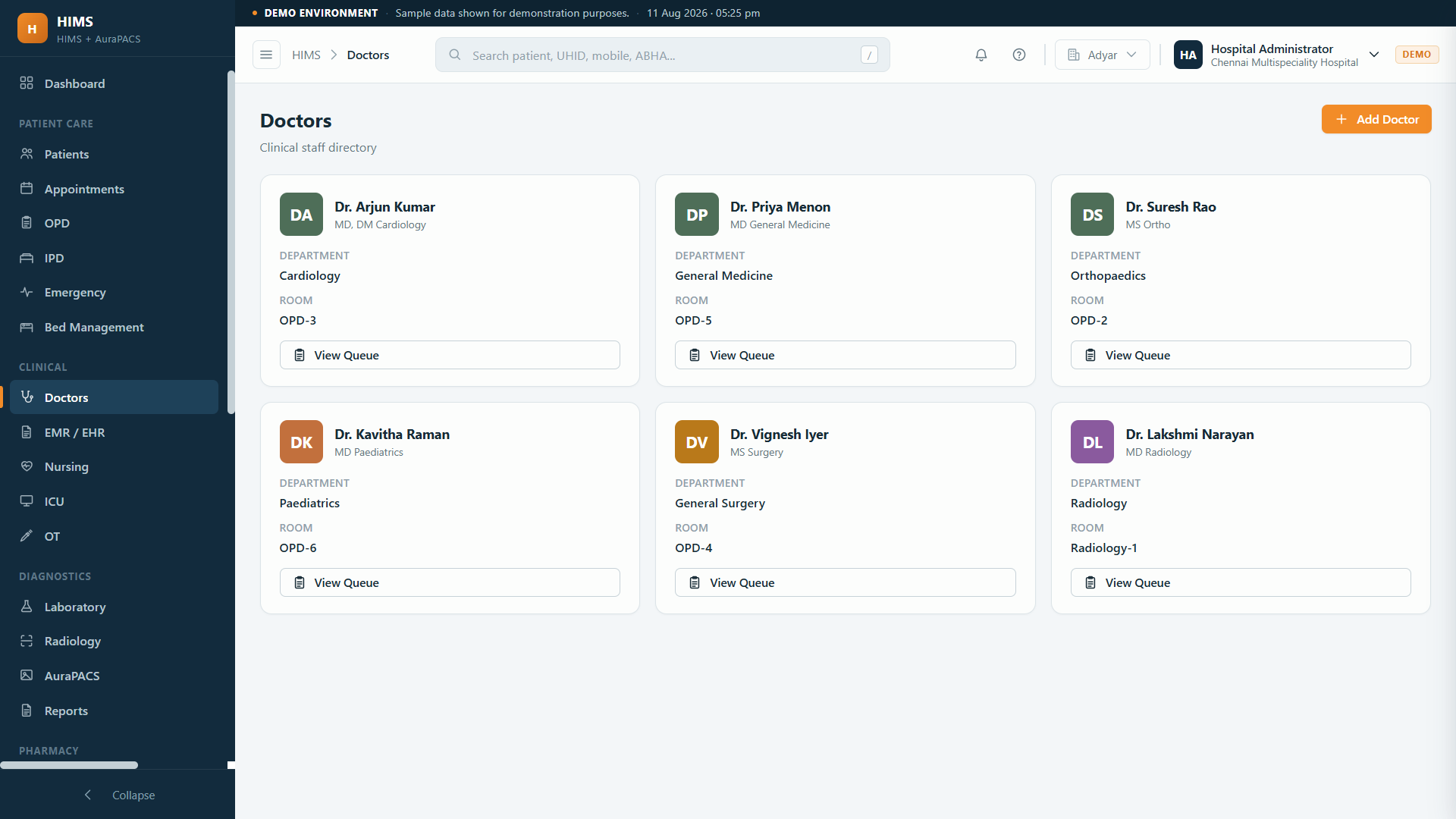
his.elevateaura.co.in/doctors
HIMS doctors screen showing consulting doctors, departments and clinic timings
In one sentence

What a polyclinic actually needs from software

A polyclinic has one thing a single-doctor clinic does not: several consultants working the same building on different days and different hours, sharing a reception, a pharmacy and often a small laboratory. The software problem is not clinical depth. It is keeping each doctor's patients, queue and record separate while the front desk handles all of them from one screen.

HIMS does that by keeping the patient identity shared and the workflow per doctor. A patient is registered once under a UHID, whichever consultant they came to see. Each doctor has their own appointment book and token queue. Prescriptions go to the shared pharmacy, investigations to the shared laboratory, and billing collects for whoever did the work, with the collections readable doctor by doctor at the end of the day.

Where polyclinics struggle

One desk, five doctors, and no agreement on anything.

Everything that works in a single clinic gets awkward as soon as a second consultant shares the reception.

One queue for everybody

Patients waiting for three different doctors sit in one corridor with no idea whose turn it is.

Registers per doctor

Each consultant keeps their own book, so the same patient is registered again for every department.

Pharmacy caught in the middle

The counter serves prescriptions from several doctors with no common format and no stock visibility.

Settlements argued at month end

Nobody can say cleanly how many consultations each doctor did or what was collected against them.

Timings only the receptionist knows

Which consultant sits on which day lives in one person's head, and collapses when they are away.

A patient at a polyclinic

Shared desk, separate consulting rooms.

01

Registered once

The counter searches, finds or creates the UHID, whichever doctor is being seen.

→
02

Sent to a doctor's queue

A token is issued against that consultant, not the clinic as a whole.

→
03

Consultation

The doctor writes on the shared patient record and prescribes from it.

→
04

Pharmacy and laboratory

The prescription reaches the shared pharmacy queue; investigations reach the shared laboratory.

→
05

Billing

Consultation, drugs and tests are collected at one counter, attributed to who did what.

→
06

Day close

The day's volume and collections can be read per doctor and per service.

What a polyclinic gets

Shared where it helps, separate where it must be.

👤Shared

  • One reception and one registration
  • One UHID per patient across consultants
  • Shared pharmacy with dispensing queue
  • Shared laboratory from order to verified result

⌚Per doctor

  • Appointment book per consultant
  • Token queue per consulting room
  • Rosters and consulting days
  • Their own notes on the shared record

₹Money

  • One billing counter for everything
  • Consultation, pharmacy and lab on one bill
  • Collections readable per doctor
  • GST where it applies

📱Around the visit

  • WhatsApp appointment and follow-up reminders
  • Patient portal for reports
  • Imaging through AuraPACS where you have it
  • Live view of the day's OP and collections

See clinic management software →

In practice

Four things that stop being arguments.

A busy evening with three consultants

Workflow: Each doctor has their own token queue and the waiting area knows which number is with whom.

Result: One corridor, three orderly queues.

A patient who sees two doctors

Workflow: Both consultations sit on the same UHID, so the second doctor sees the first one's notes and prescription.

Result: The patient stops being the messenger.

The pharmacy counter

Workflow: Prescriptions from every consultant arrive in one dispensing queue, drawn from stock the counter actually holds.

Result: No handwriting, no unavailable items.

End of the month

Workflow: Consultations and collections are read per doctor for the period from the same records that billed them.

Result: The settlement conversation starts from agreed numbers.

Who it is for

Buildings with more than one consulting room.

🩺
Polyclinics

Several specialties, one reception.

👨‍⚕️
Visiting consultants

Doctors who sit two evenings a week.

🏦
Clinics with a pharmacy

Prescription to counter without a slip.

🔬
Clinics with a lab

Orders and verified results on the record.

💼
Owners and managers

Volume and collections per doctor.

The honest comparison

Three ways polyclinics are run.

 
Paper registers and Excel
Standalone billing software
HIMS by Elevate Aura
Patient identity
A register per doctor
A customer per bill
One UHID across consultants
Waiting
One corridor, no order
Not covered
A token queue per doctor
Pharmacy
Slips read at the counter
Billed, not dispensed
Dispensing queue from stock
Per-doctor numbers
Counted by hand
Filtered from invoices
Read from the day's records
Growing into IP later
Start again
Start again
Switch on the modules you need
Questions

Polyclinic software, answered.

Can each doctor have their own queue?

Yes. Tokens are issued against the consultant rather than the clinic, so three doctors sitting at the same time each have their own order of patients while the front desk works from one screen. See queue management.

Do consultants see each other's notes?

The patient record is shared, and what each role can see is controlled by role-based access configured at setup. Most polyclinics want continuity across consultants, which is the point of one UHID, but the access rules are yours to decide.

Can we work out what each doctor is owed?

Consultations and collections are readable per doctor for any period, which is the data a settlement needs. If you want a specific share or payout calculation automated, describe the arrangement on the call so it is scoped rather than assumed.

Is this different from clinic software?

It is the same platform with the multi-doctor parts switched on: a book and queue per consultant, shared pharmacy and lab, and per-doctor reporting. A single-doctor practice needs less. See clinic management software.

What if we add beds later?

The IP modules, bed management, admission and discharge, sit in the same platform and are switched on when you need them. Nothing has to be migrated because the patient record is already there.

When would a polyclinic be running on it?

HIMS is delivered to a fixed scope and goes live in 30 working days where the scope allows. Setup, data migration from your existing sheets and training at your own counter are part of that.
Keep exploring

Related HIMS pages

Let's talk about your requirement.

Tell us how you work today. We will show you what the platform would look like for you, and give you a clear scope and timeline.

Founder-led · Chennai, India · Built and supported by the person who wrote it