← Elevate Aura  ·  HIMS & AuraPACS clinical software Chennai, India · WhatsApp
For hospitals with many departments

Multi-specialty hospital software where every department reads the same record.

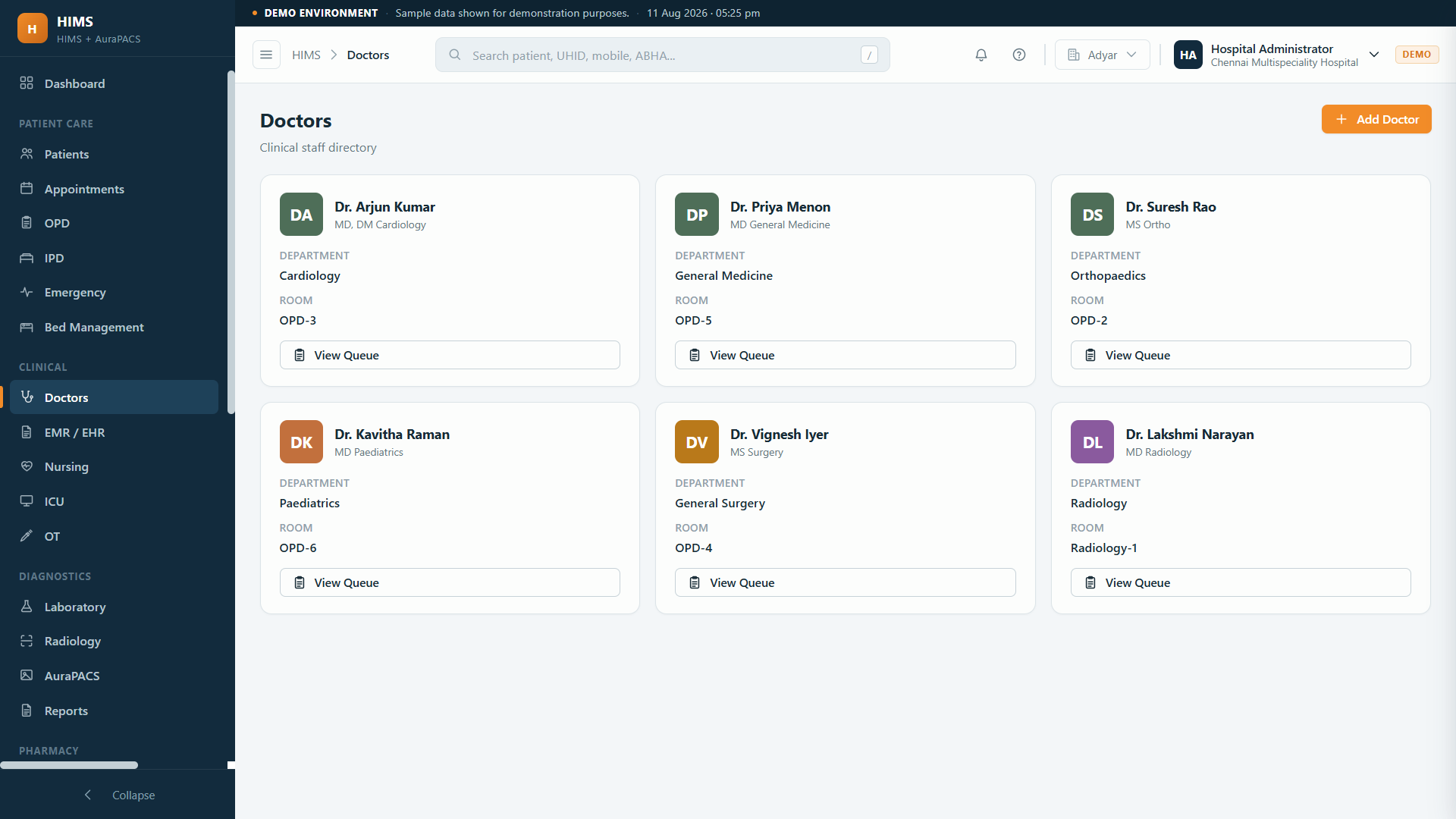
HIMS runs a multi-specialty hospital as one system: a single patient record that cardiology, orthopaedics, medicine and surgery all write to, doctor rosters and queues by department, one pharmacy and one laboratory serving everyone, and a dashboard of OP, IP, beds and collections.

One record across every departmentDoctor rosters and queues by departmentShared pharmacy, lab and imaging
his.elevateaura.co.in/doctors
HIMS doctors directory showing clinical staff by department with their queues
In one sentence

What multi-specialty hospital software has to do

Multi-specialty hospital software has one job that a clinic system does not: keep many departments, each with its own doctors, queues and habits, writing to a single patient record and drawing on shared services. HIMS does this by treating a department as a view of the hospital rather than a separate system. Cardiology and orthopaedics see their own rosters and queues, but the pharmacy they prescribe to, the laboratory they order from and the bed board they admit to are the same for everyone.

For management the payoff is a live dashboard of the whole hospital: OP visits, admissions, bed occupancy and collections across departments on one screen, instead of a monthly compilation from each department's register. AuraPACS imaging is built in, so radiology is one more department on the same record rather than an external service.
The department-silo problem

A hospital with eight departments often has eight ways of keeping records.

Growth adds departments faster than it adds systems, so each one improvises.

Cross-referrals lose the file

A medicine patient referred to cardiology is registered again, and the first consultant's notes never reach the second.

Rosters on a noticeboard

Which consultant sits in which room on which afternoon is known to the department secretary and nobody else.

Every department wants its own pharmacy

Stock is split, expiry is missed and the same drug is reordered by three people.

Lab reports collected by hand

Reports are printed in the laboratory and carried to the department, and a percentage of them arrive after the patient has left.

Management sees last month

Department heads compile numbers for a review meeting, and the figures disagree with the accounts.

One patient, many departments

How a cross-department case runs on HIMS.

01

Registered once

UHID created at the first visit, reused at every department.

→
02

Department queue

Token issued for the consultant on that department's roster.

→
03

Referral

The consultant refers to another department; the record goes with the patient.

→
04

Shared services

Orders to the one laboratory, one pharmacy and AuraPACS, whoever raised them.

→
05

Admission

Bed allocated from the hospital board under the admitting department.

→
06

One bill, one dashboard

Charges from every department on the same bill; totals on the live dashboard.

What is included

Department structure on a single platform.

🏥Departments

  • Doctors grouped by department
  • Rosters and availability per department
  • Queues per doctor and per department
  • Cross-department referrals on the record

📋One record

  • Structured EMR shared across departments
  • e-Prescription from any consultant
  • Full history across visits and admissions
  • Supports NABH-style documentation

💊Shared services

  • Central pharmacy with dispensing queue
  • Laboratory (LIMS) from order to verified result
  • AuraPACS imaging on the record
  • Inventory with reorder levels

📊Management

  • Live dashboard of OP, IP, beds and collections
  • Cash, insurance and TPA billing in one view
  • Role-based access by department and role
  • Patient app and portal

See the full hospital management system →

In practice

What changes across the hospital.

A referral from medicine to cardiology

Workflow: The physician refers on the record; the patient is queued for the cardiologist, who reads the physician's notes and the morning's lab results before the consultation.

Result: One visit, two departments, no second registration.

A visiting surgeon's Tuesday clinic

Workflow: The roster shows the surgeon in room four from two o'clock; tokens open for that session and the queue appears on the OPD dashboard.

Result: The front desk answers availability from the roster.

One pharmacy for eight departments

Workflow: Prescriptions from every department land in the same dispensing queue; low-stock and expiry alerts cover the whole hospital.

Result: Stock is bought once and watched once.

The Monday review

Workflow: Management opens the dashboard for OP, admissions, occupancy and collections, filtered as needed.

Result: The meeting starts from live numbers.

Who it is for

Hospitals where departments have outgrown the shared register.

🏥
Multi-specialty hospitals

Medicine, surgery and the specialties on one platform.

🏦
Growing nursing homes

Adding departments without adding systems.

👨‍⚕️
Department heads

Their roster, their queue, the shared record.

📊
Management

One dashboard for the whole hospital.

💻
Hospital IT

One platform to run instead of many.

The honest comparison

Running many departments, three ways.

 
Paper registers and Excel
Enterprise hospital ERP
HIMS by Elevate Aura
Patient record
One file per department
One record, heavy configuration
One record, configured to your departments
Rosters and queues
Noticeboard
Module, often extra
Built in, per department
Pharmacy and lab
Separate registers
Separate modules and licences
Shared services on the same platform
Imaging
External
Third-party PACS interface
AuraPACS built in
Delivery
None
Months, large team
30-day framework where scope allows, founder-led
Questions

Multi-specialty hospital software, answered.

Do departments get their own screens?

Each department has its own doctors, rosters and queues, and consultants see their own patients. The record underneath is shared, so a referral or an admission carries the full history. See doctor management software.

Does HIMS have specialty-specific EMR templates?

The EMR is structured for history, examination, orders, notes and reports and is used the same way by every department. Specialty-specific forms are not on record as separate modules; tell us what a department needs and it is scoped on the call.

Can the pharmacy and laboratory serve all departments?

Yes. There is one pharmacy with one dispensing queue and one laboratory with one worklist. Orders from any department land there and results return to the ordering consultant on the patient's record.

How is imaging handled across departments?

AuraPACS is built into HIMS. Any department can order a study, the study lands from the machine, the radiologist reports in the browser viewer and the report attaches to the record. See hospital PACS software.

Can management see department-wise numbers?

The live dashboard shows OP, IP, beds and collections for the hospital, and doctor and department views show queues and load. How you want numbers cut for review meetings is set up during the project.

How long does a multi-department rollout take?

HIMS is delivered on a 30-working-day framework where scope allows. Larger hospitals usually go live department by department on the same record, starting with OP and billing. See HIMS vs hospital ERP if you are weighing a larger system.

Keep exploring

Related HIMS pages

Let's talk about your requirement.

Tell us how you work today. We will show you what the platform would look like for you, and give you a clear scope and timeline.

Founder-led · Chennai, India · Built and supported by the person who wrote it