At a hundred beds the hospital has real departments, three shifts and more than one billing point. The things that worked at fifty beds, one desk and one person who knows everything, start to fail. HIMS is built for the handover.

A hundred-bed hospital is not a fifty-bed hospital with more beds. It has departments that run their own rosters, nursing shifts that hand over three times a day, a billing point in more than one area, enough insurance and TPA work to justify a desk for it, and an administrator whose job is the hospital rather than the patients. The informal method that held a smaller hospital together, which was one person who knew everything, does not reach across three shifts.
So the software has to carry the things people used to carry. Nursing entries are timed and attributed so a shift handing over leaves a record rather than a conversation. Each billing point works from the same patient account, so an outpatient bill, a pharmacy sale and an inpatient running bill do not have to be reconciled afterwards. Pre-authorisation and claims sit with the TPA desk. And the administrator opens a live dashboard of outpatients, admissions, bed occupancy and collections instead of waiting for department registers to be compiled.
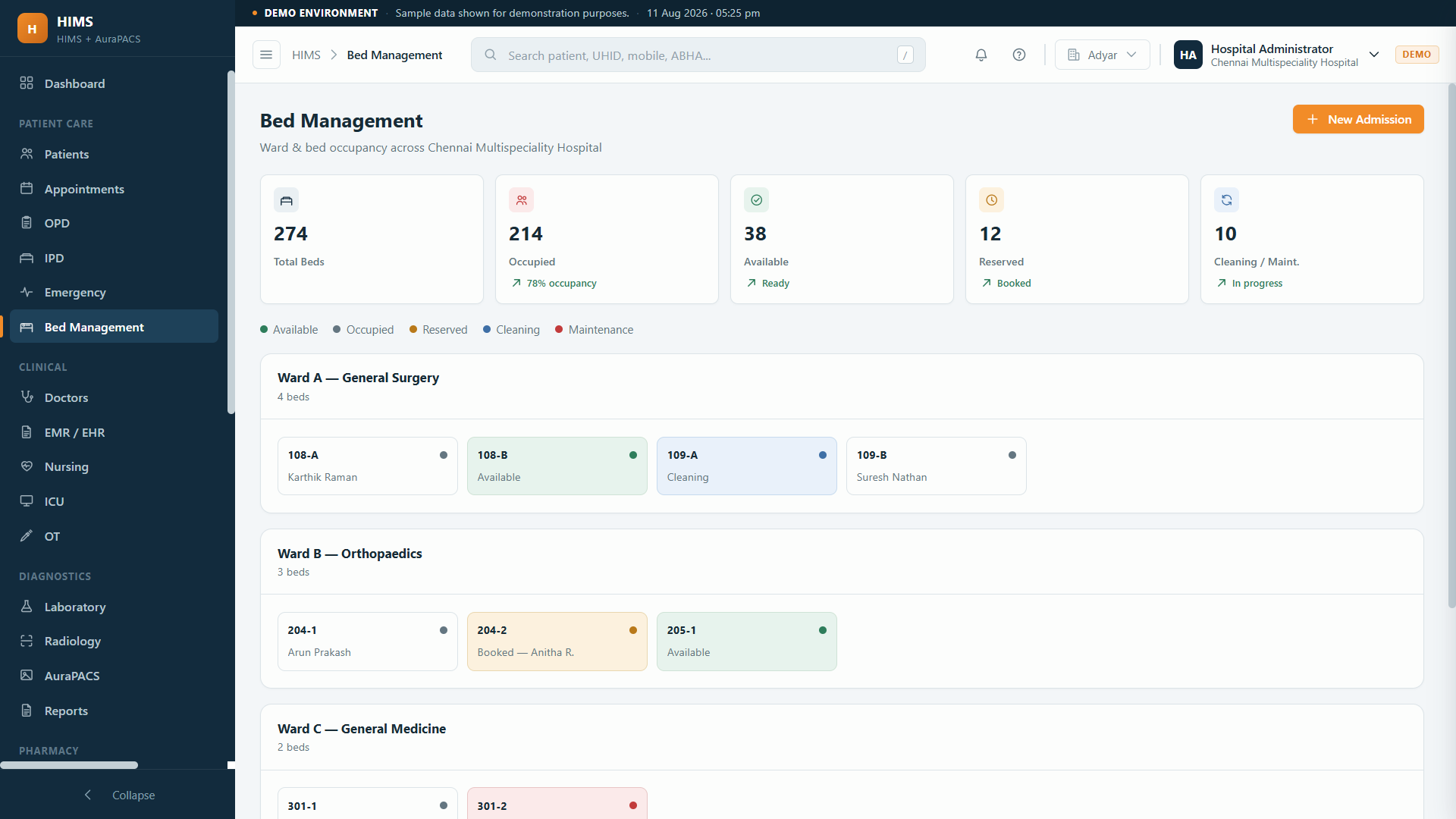
These are the symptoms that a mid-size hospital has outgrown its arrangements.
What happened on the night shift is passed on verbally, and whatever is not said is lost.
Pharmacy, laboratory and the ward each issue their own slips, and someone adds them up at discharge.
Claim volume is now large enough that a backlog of pending authorisations has become normal.
Occupancy and collections arrive as a compiled report, too late to change anything.
Each department trusts its own book, so no two numbers in the hospital agree.
An entry is questioned and there is no reliable record of who made it or when.
Registration and queues run per department, with consultants on their own rosters.
Beds are allocated from a board that every ward and the front desk can see.
Vitals, medication administration and notes are recorded against the patient as timed, attributed entries.
The incoming shift reads the record rather than relying on what was mentioned at the door.
Pharmacy, laboratory and the wards post to the same patient account through the day.
Pre-authorisations, queries and claim documents are worked from the record as a queue.
The administrator reads outpatients, admissions, occupancy and collections on the live dashboard.
Workflow: Every observation and administration is timed and attributed on the patient record.
Result: The morning round starts from what happened, not from what was remembered.
Workflow: The inpatient bill has been accruing from every posting point since admission.
Result: The bed is released hours earlier.
Workflow: Pre-authorisations and pending claims are a worklist rather than a pile of files.
Result: The backlog becomes visible and therefore manageable.
Workflow: Occupancy, outpatient numbers and yesterday's collections are read from the dashboard.
Result: Decisions are made on today's figures.
Workflow: The audit trail shows who made the change and when.
Result: The question is settled in a minute.
Several departments, three shifts.
Accountable for numbers every day.
A desk dedicated to claims.
Theatres, ICU and planned lists.
Outgrowing the arrangements that worked.
Three things. Verbal handover stops being reliable across three shifts, bills assembled from separate counters stop reconciling, and monthly compiled reports stop being fast enough for an administrator. All three are record-keeping problems rather than capacity problems.
Yes. Access is role based, so a department sees its own rosters and queues while the pharmacy, laboratory and bed board stay shared. Changes are recorded in an audit trail.
Yes. Pharmacy, laboratory and the wards post to the same patient account, so an inpatient bill accrues through the stay rather than being assembled at discharge. See IPD management.
Delivery follows a 30-working-day framework where scope allows, and at this size the scope is agreed carefully before anything is configured. Larger scope takes longer, and that is said on the call rather than discovered later.
HIMS is delivered as a cloud workspace used from a browser. AuraPACS imaging uses an on-premise node on your own network for the machines, with a thin cloud layer for remote viewing. Deployment specifics are settled on the call.
The EMR is structured and supports NABH-style documentation, with timed entries and an audit trail. Elevate Aura makes no certification claim about the software itself; accreditation is the hospital's process.
Tell us how you work today. We will show you what the platform would look like for you, and give you a clear scope and timeline.
Founder-led · Chennai, India · Built and supported by the person who wrote it