← Elevate Aura  ·  HIMS & AuraPACS clinical software Chennai, India · WhatsApp
For accounts and front office

Hospital credit and corporate billing that knows which company owes what.

When the patient is not the payer, the bill still has to be right. HIMS bills corporate panels and empanelled organisations on credit, keeps the outstanding per company visible, and produces statements from the same admissions that generated the bills.

Companies and panels billed on creditOutstanding per organisationStatements from the same records
his.elevateaura.co.in/billing
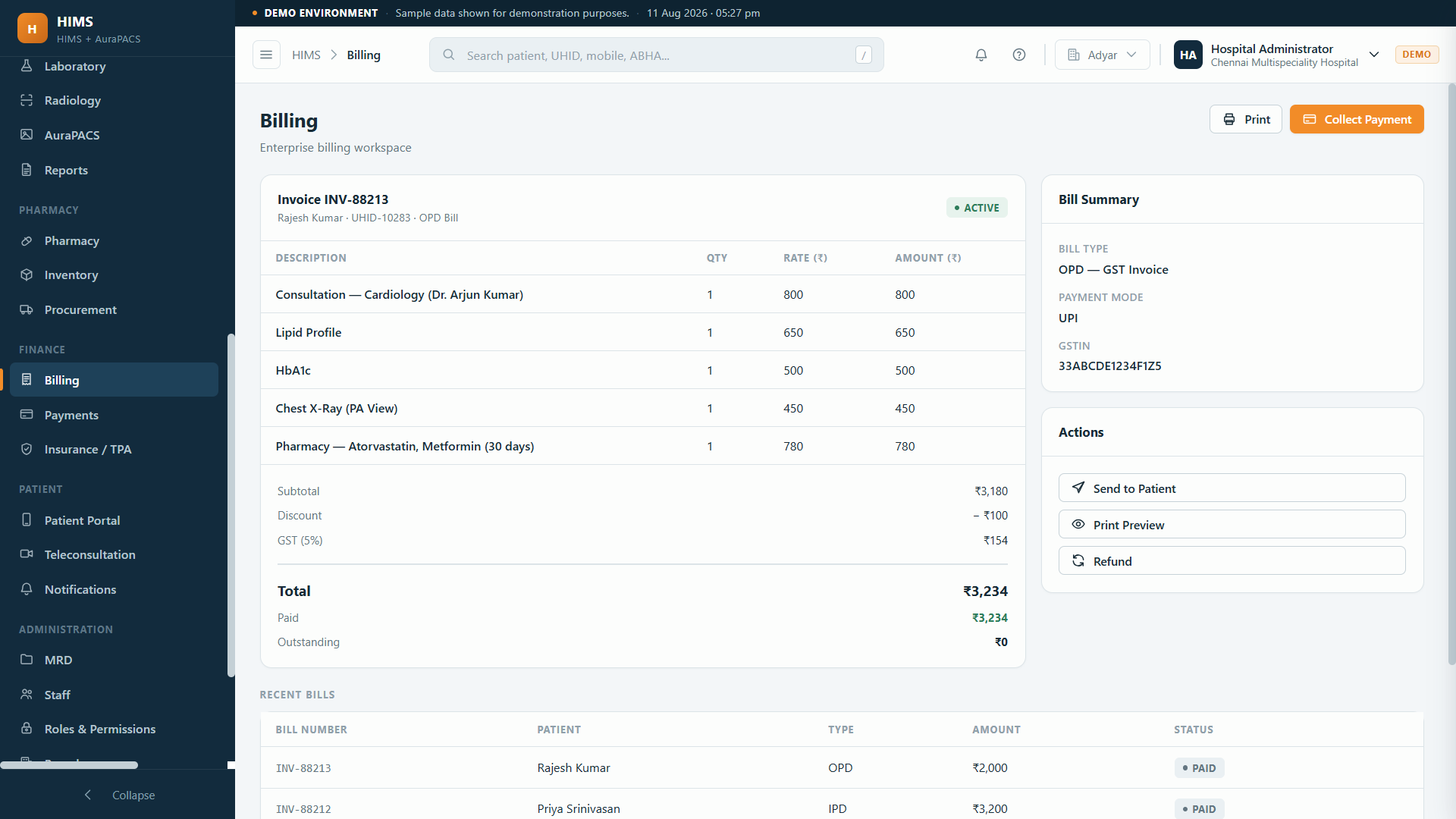
HIMS billing screen showing a hospital invoice raised against a corporate payer on credit
In one sentence

What credit and corporate billing covers

Corporate billing is what happens when an employer, an institution or an empanelled organisation has agreed to pay for its people. The patient is treated and discharged without paying at the counter, the bill is raised against the company on credit, and the hospital then waits. HIMS records that from the moment the patient registers, so the front desk knows the payer before the first charge is posted rather than discovering it at discharge.

The part that matters most is what comes after. Bills raised on credit sit against the organisation, not against a pile of loose invoices, so accounts can see what each company owes, which bills make up that figure and what has been received. It is the same billing module that handles cash, insurance and TPA claims, so a hospital with all four kinds of payer is still looking at one set of books.
Why corporate money arrives late

Credit billing usually fails at the follow-up, not the bill.

The bill gets raised. Then it disappears into a file until someone asks.

Payer found out at discharge

The patient mentions the company entitlement at the counter and the whole bill is reworked on the spot.

Invoices tracked in a side register

Credit bills are copied into a separate book, and the book and the system stop agreeing within a month.

Statements typed from scratch

When a company asks what it owes, somebody spends a morning listing bills by hand.

Part payments unallocated

A company pays a lump sum against several bills and nobody records which ones it cleared.

Nobody owns the chase

Without a per-organisation outstanding figure, follow-up happens when cash runs short.

One credit patient

From registration to the company's payment.

01

Organisation recorded

The company or panel is set up once, with the entitlement it covers.

→
02

Payer set at registration

The patient is registered against that organisation, so billing knows from the start.

→
03

Charges accrue

OP consultations or the IP stay post to the bill as normal.

→
04

Bill raised on credit

The company portion is billed to the organisation; anything not covered is collected from the patient.

→
05

Outstanding tracked

The bill sits against the organisation in the outstanding view.

→
06

Statement and receipt

A statement of bills is produced for the company and payments are recorded against them.

What is included

Credit billing beside cash, insurance and TPA.

🏢Organisations

  • Corporate and empanelled organisation master
  • What each panel covers
  • Patients linked to their organisation
  • Payer known at registration

₹Billing

  • Company portion billed on credit
  • Patient portion collected at the counter
  • OP consultations and IP admissions alike
  • Packages billed to a panel

📋Following the money

  • Outstanding per organisation
  • Bills that make up the outstanding
  • Receipts recorded against bills
  • Part payments visible

📊Reporting

  • Payer mix across cash, TPA and corporate
  • Collections on the live dashboard
  • Statements per organisation
  • Audit trail per bill

See hospital billing in full →

In practice

Four moments accounts will recognise.

An employee walks into OP

Workflow: Registration links the patient to the company, so the consultation is billed to the panel rather than collected in cash.

Result: No rework at the counter.

A company asks for a statement

Workflow: The bills raised against that organisation for the period are listed with what is paid and what is open.

Result: The statement takes minutes, not a morning.

A lump sum arrives

Workflow: The receipt is recorded and allocated against the specific bills it clears.

Result: The outstanding drops by the right amount.

Month-end review

Workflow: The owner reads outstanding by organisation alongside TPA claims and cash collections.

Result: Follow-up goes where the money actually is.

Who it is for

Hospitals with tie-ups, not just walk-ins.

🏥
Hospitals with corporate panels

Employer tie-ups billed monthly.

🏢
Occupational health tie-ups

Check-ups and consultations billed to an institution.

₹
Accounts teams

One outstanding figure per organisation.

👤
Front office

Payer known before the first charge.

💼
Owners

Credit exposure visible on the dashboard.

The honest comparison

Three ways credit bills get tracked.

 
Paper registers and Excel
Standalone billing software
HIMS by Elevate Aura
When the payer is known
At discharge
At billing
At registration
Where credit bills sit
A side register
In the invoice list
Against the organisation
Statements
Typed by hand
Exported and edited
Produced from the bills themselves
Part payments
Noted in the margin
A single receipt entry
Allocated against specific bills
Seen beside TPA and cash
Three registers
Separate reports
One payer view on the dashboard
Questions

Corporate and credit billing, answered.

Is corporate billing different from TPA billing?

Yes. A TPA settles an insurance claim with pre-authorisation and claim documents. A corporate panel is a direct credit arrangement with an organisation. Both are handled in the same billing module. See TPA and insurance billing.

Can part of a bill go to the company and part to the patient?

Yes. The portion the organisation covers is billed on credit and the balance is collected from the patient on the same bill, so there is no second invoice and nothing to reconcile afterwards.

How do we see what a company owes us?

Outstanding is held per organisation, with the bills that make it up and the receipts recorded against them. That figure also appears alongside TPA and cash on the MIS dashboard.

Can we bill a package to a corporate panel?

Yes. A package can be billed to an organisation on credit, with the inclusions resolving the same way they do for a cash patient. See package billing.

Does it handle OP consultations on credit, not just admissions?

Yes. An empanelled employee coming to OP is registered against the organisation and the consultation is billed to the panel, which is often the bulk of corporate volume.

Is GST applied on corporate bills?

Billing in HIMS is GST-native, and tax is applied where your accountant says it applies using rules configured at setup. What the correct treatment is for a given corporate arrangement is a question for your auditor rather than for the software.

Keep exploring

Related HIMS modules

Let's talk about your requirement.

Tell us how you work today. We will show you what the platform would look like for you, and give you a clear scope and timeline.

Founder-led · Chennai, India · Built and supported by the person who wrote it