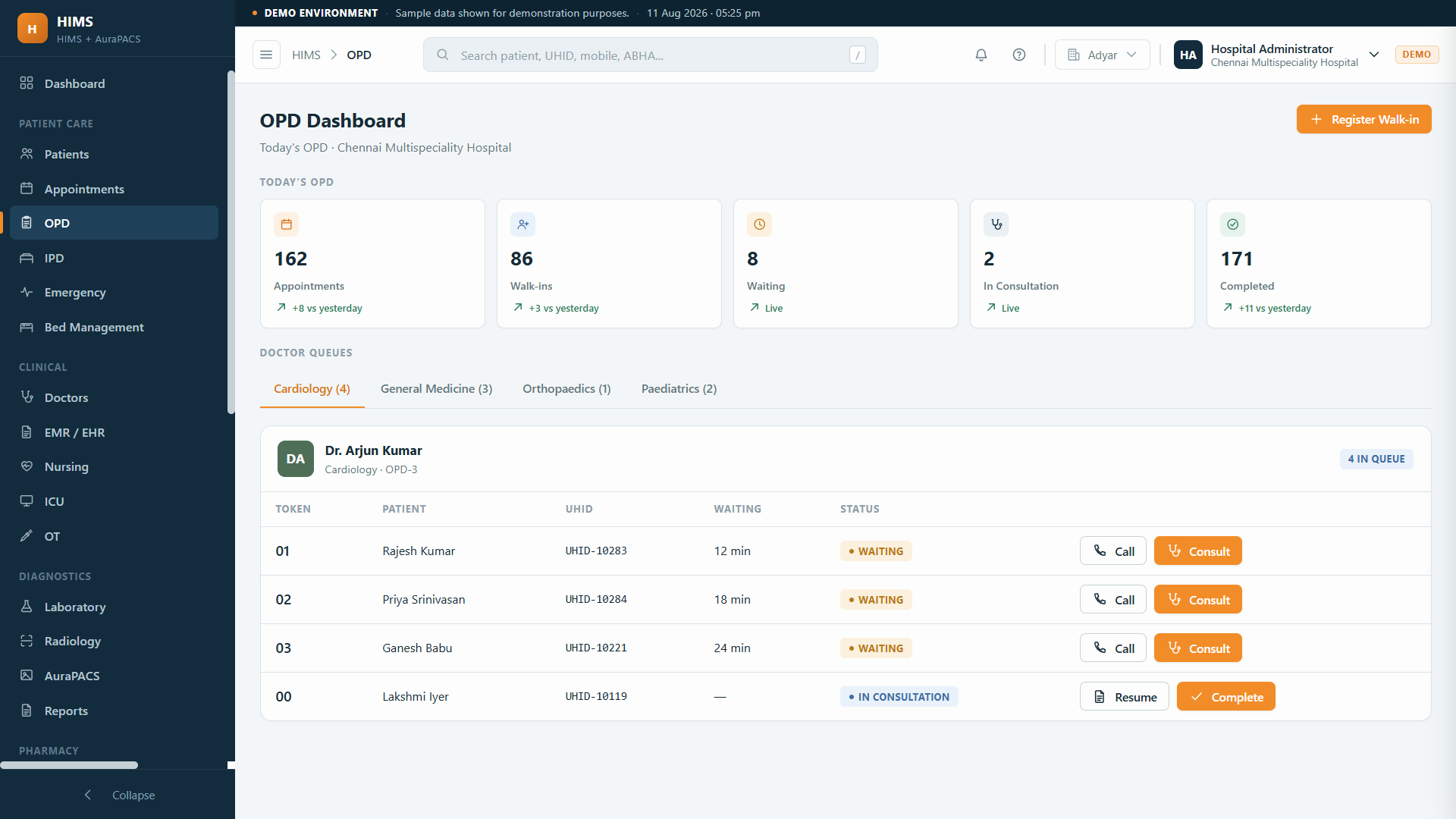
Most owners do not want to operate the software. They want one screen that says what came in today, how full the hospital is, how many patients came through OP and how much money is still sitting with TPAs and companies.

An owner needs four things on one screen: what was collected, how full the beds are, how many patients came through OP, and how much money is owed to the hospital and by whom. Everything else can wait. In HIMS those four figures come from the registrations, admissions and bills the hospital made during the day, so there is nothing to compile and nobody to ask.
The dashboard is deliberately shallow at the top and deep underneath. The headline says collections today. One level down it splits by payer, so cash sits next to what the TPAs and corporate panels still owe. Occupancy breaks down by ward. OP volume breaks down by department and doctor. An owner who wants only the headline can stop at the headline, and one who wants to know why can keep going until they reach the entry.
It is also the one screen that does not depend on anybody being available. The administrator may be on leave and the accountant may be at the bank, and the owner can still see what the hospital did today without asking either of them for it.
The information exists. It just reaches the owner last, and edited.
Beds from the ward, money from the counter, OP from the front desk, and no way to check any of it.
By the time the statement is ready, the month it describes cannot be changed.
What was collected is roughly known. What is stuck with TPAs and companies is somebody else's problem.
This week against last week, this doctor against that one, is guesswork without comparable data.
When the accountant or the administrator is away, the owner cannot answer basic questions about their own hospital.
What has actually been received, from all payers, as it happens.
How much of it is cash and how much is waiting on a TPA or a company.
Occupancy by ward, admissions in and discharges out today.
Patients seen, by department and by doctor.
What is owed to the hospital, and by which TPA or organisation.
Whatever looks wrong is opened down to the bill or the admission behind it.
Workflow: Collections, occupancy and OP volume are read on the phone at the end of the evening.
Result: The round of calls stops.
Workflow: Outstanding is read per TPA and per company alongside what was actually collected.
Result: The gap has a name and an amount.
Workflow: OP volume and billing for that doctor across the period are compared with the clinic hours given.
Result: The arrangement is reviewed on data.
Workflow: The same screen is read from anywhere, because the system runs in the cloud.
Result: Being away stops meaning being uninformed.
One screen instead of four calls.
Running a hospital between consultations.
No administrator to compile numbers.
Departmental comparison that holds up.
The same figures the counter produced.
No. The dashboard is the only screen most owners open. Everything on it is produced by the staff doing their normal work, so there is nothing for you to enter and nothing to maintain.
Yes. HIMS runs in the cloud with a live demo at his.elevateaura.co.in, so the same screen opens on a phone or a laptop wherever you are, subject to the access your role has.
Yes. Outstanding is held per payer, so claims sitting with each TPA and balances with each corporate panel appear next to cash collections. Claim detail is in TPA and insurance billing.
Only what their role allows. Access is role based, so collections, payer detail and departmental performance can be restricted to the people who should have them.
They come from the registration, admission and billing entries themselves rather than a summary somebody typed. Any figure can be opened down to the bills or admissions behind it, and entries are attributed and timed.
It is usually the opposite. A small hospital has no administrator to compile numbers, so the dashboard is often the first reason an owner buys. See small hospital software.
Tell us how you work today. We will show you what the platform would look like for you, and give you a clear scope and timeline.
Founder-led · Chennai, India · Built and supported by the person who wrote it